Technology
Apache Kafka
The Evolution of Data - From Databases to Event Streams
In traditional backend applications, systems were designed to store data as static snapshots in a relational database. When a user placed an order or updated a profile, the application modified a row in a table, overwriting the previous state. However, as modern software scaled into distributed microservices and real-time processing, treating data as static entries created massive integration challenges and data bottlenecks. Engineers needed a way to capture data not just as a final state, but as a continuous, immutable stream of events happening over time. Apache Kafka emerged as the industry standard for event streaming, fundamentally changing how large-scale applications handle high-throughput, real-time data flows across complex infrastructure.
Understanding Kafka's Core Architecture - Publishers, Topics, and Consumers
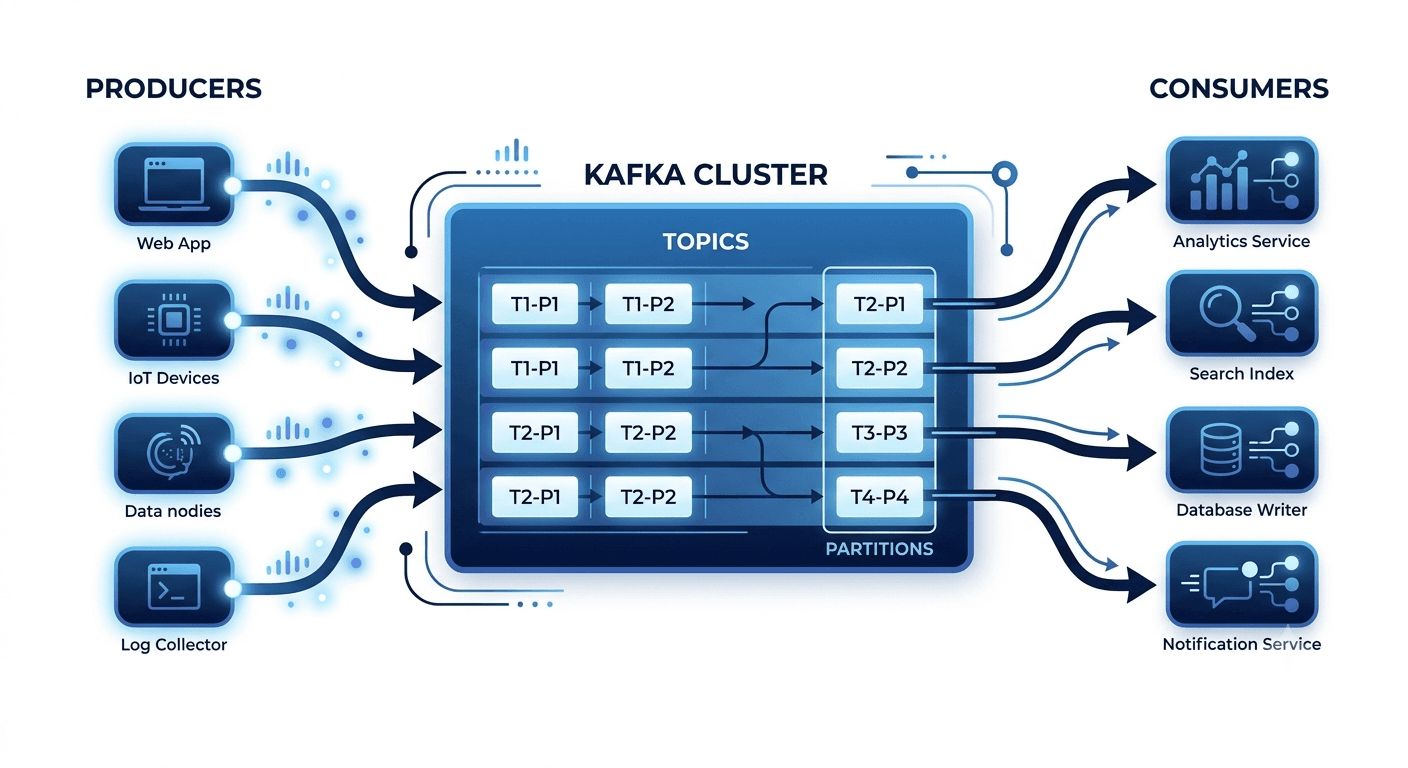
At its core, Apache Kafka operates as a distributed publish-subscribe messaging system designed for high throughput and fault tolerance. To understand how Kafka handles millions of events per second, it helps to break down its primary components into three main roles. Producers are the client applications that create and send event messages into Kafka. These messages are organized and stored in named categories called Topics, which act as logs that hold events in the order they occurred. Finally, Consumers are the applications that subscribe to these topics and process the incoming events asynchronously. This separation between publishers and subscribers allows different microservices to read and write data independently without blocking each other or causing system latency.
Scalability and Resilience through Partitions and Brokers
To achieve extreme performance and prevent single points of failure, Kafka relies on a distributed cluster of servers known as Brokers. Every topic created in Kafka can be divided into smaller units called Partitions, which are distributed across multiple brokers in the cluster. Partitioning allows Kafka to scale horizontally by spreading the storage and read/write operations across multiple machines simultaneously. Furthermore, Kafka ensures fault tolerance by replicating these partitions across different servers. If a broker hosting a specific partition crashes, a replica instantly takes over, guaranteeing that critical event data is never lost and real-time streams remain uninterrupted.
Key Use Cases - Where Kafka Fits in Modern Backend Architecture
While traditional message queues like RabbitMQ are designed for short-lived messaging between services, Kafka excels at processing continuous, high-volume event streams at massive scale. Popular use cases for Apache Kafka include:
Real-time Analytics - Aggregating web traffic, user interactions, or telemetry data from IoT devices for live dashboards.
Microservices Communication - Serving as the central event bus in an event-driven architecture to decouple services.
Log Aggregation - Collecting application logs from hundreds of servers and funneling them into a centralized storage engine.
Financial Transaction Processing - Tracking user payments and fraud detection events with strict order guarantees.
Why Kafka is an Essential Tool for Future Backend Engineers
For software engineering students and junior developers, learning the fundamentals of event streaming is a crucial step toward designing modern distributed systems. As applications continue to move toward real-time features such as live tracking, instant notifications, and AI model ingestion understanding how Kafka processes events asynchronously will give you a significant edge in backend development. Building personal projects that incorporate Kafka demonstrates to tech leaders that you can think beyond simple CRUD operations and build scalable, production-grade architectures capable of handling real-world data demands.
Test Your Knowledge!
Click the button below to generate an AI-powered quiz based on this article.
Did you enjoy this article?
Show your appreciation by giving it a like!
Conversation (0)
Cite This Article
Generating...