Technology
When Chips Think Like Brains - A Gentle Introduction to Neuromorphic Computing
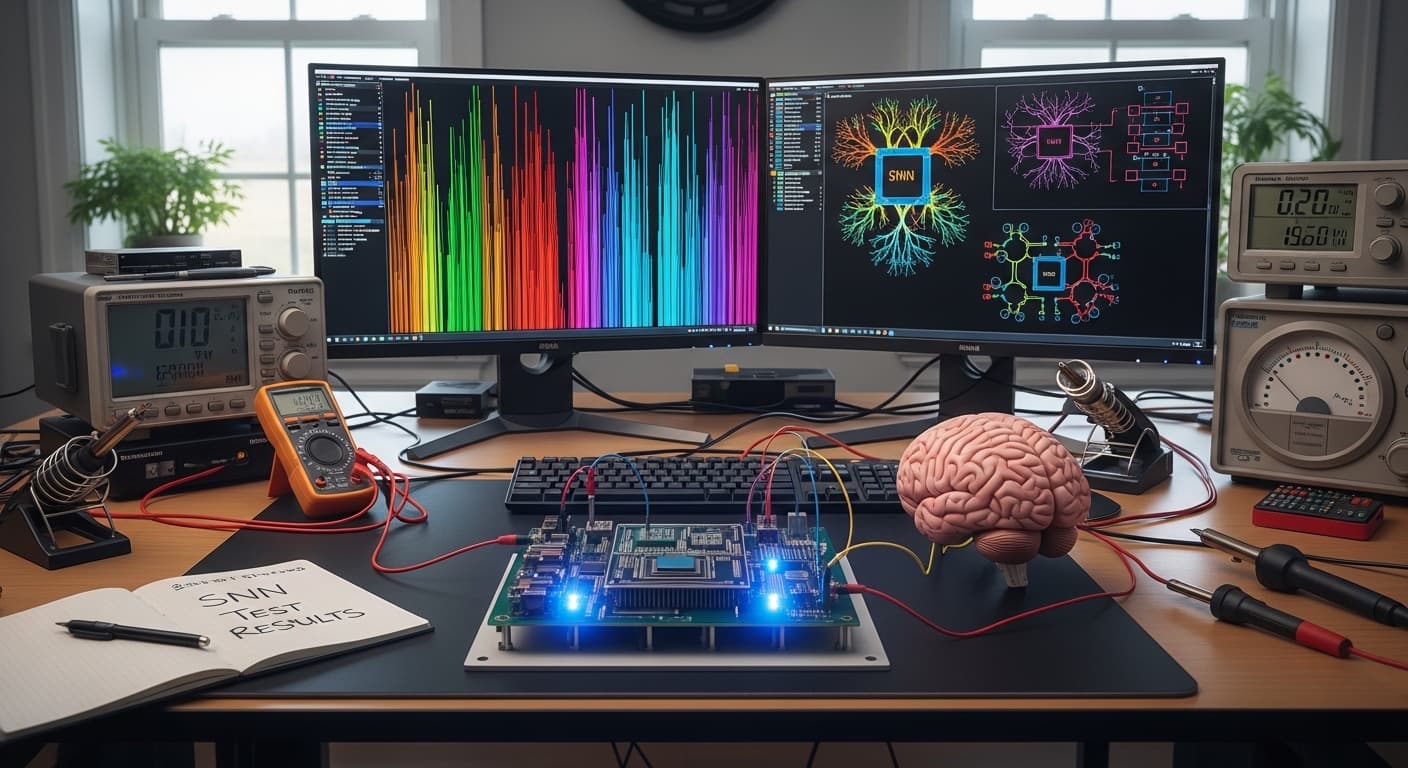
Most of today's AI runs on hardware originally designed for calculators and spreadsheets, not for thinking like a brain. It works impressively well, but it burns a lot of power and struggles with tasks humans find effortless like walking through a busy room or understanding speech in a noisy café. Neuromorphic computing takes a different path, instead of just copying the software of the brain, it redesigns the hardware itself so chips behave more like networks of biological neurons.
You can think of it as asking, what if computers did not just do math faster, but actually processed information more like our brains do?
Why Copy the Brain in the First Place?
The human brain is a tiny energy miracle. It runs on about 20 watts less than many light bulbs yet handles vision, language, memory, decision-making, and motor control all at once. Traditional computers spend a lot of energy moving data back and forth between memory and processor. That constant traffic is a major bottleneck.
Neuromorphic computing aims to shrink that gap. By organizing tiny processing units and memory in brain-like networks, these chips handle certain tasks especially those involving streams of sensory data using far less energy and with lower delay. Instead of forcing brain-inspired algorithms to run on old-style hardware, neuromorphic systems try to align the hardware with the way the algorithms think.
Neurons, Synapses, and Spikes
In your brain, billions of neurons communicate using short electrical pulses called spikes. Each neuron collects signals from many others through connections called synapses. If the combined input is strong enough, the neuron fires its own spike. Over time, synapses strengthen or weaken, which is how learning happens.
Neuromorphic chips borrow this idea:
- They contain simple electronic neurons that generate and receive spikes.
- They use synapses implemented as electronic components whose strength can be tuned to store what has been learned.
- They run in an event-driven way, if nothing changes, nothing happens. The chip mostly idles until spikes arrive, which saves power.
A good analogy is city lighting at night. Traditional chips are like leaving every light on in every building, just in case. Neuromorphic chips are like using motion sensors, most lights are off until something moves. That is ideal for devices that must listen, watch, or react without wasting energy.
How Neuromorphic Chips Differ from Normal Chips
In a typical computer, the processor (CPU or GPU) and memory are separate. Data must constantly travel between them, like cars on a busy highway. This is fine for many tasks, but for large AI models it becomes a major source of delay and power use.
Neuromorphic architectures blur this separation. They distribute processing and memory across many small units, each storing its own connection weights and handling its own spikes locally. Instead of one central brain for the chip, you get a huge network of small, simple processing elements working in parallel.
This structure is particularly good when:
- Data arrives continuously like in camera frames, microphone signals, sensor readings.
- The system needs quick reactions, like a robot balancing, a drone avoiding obstacles.
- Power is limited as in battery-powered devices, remote sensors, wearables.
Traditional chips excel at crunching large, well-structured batches of data. Neuromorphic chips aim to excel at continuous, real-time interaction with the world.
Real-World Applications - Where Neuromorphic Shines
Because of their efficiency and responsiveness, neuromorphic systems are attractive in several emerging areas:
Robotics
Robots need to constantly read sensors, update their understanding of the environment, and adjust their movements often in fractions of a second. Neuromorphic chips can process these sensory spikes locally and quickly, reducing the need to send everything to a cloud server. This means smoother motion, faster reflexes, and longer battery life for walking robots, drones, or robotic arms.
Edge AI and Wearables
Devices like smart earbuds, AR glasses, home assistants, and health wearables benefit from always-on sensing, but cannot afford heavy computation all the time. A neuromorphic chip can listen for a wake word or monitor heart signals while consuming very little power, waking up more complex processing only when needed. That improves privacy and battery life.
Always-On Sensing in the Environment
Imagine smart cameras that only react to unusual motion, or environmental sensors that only send an alert when patterns change significantly. Because neuromorphic systems are event-driven, they are well suited to this mostly quiet, sometimes active world.
Will Neuromorphic Chips Replace GPUs?
Probably not in the near future and that is okay. Right now, most of AI's training and many production systems rely on GPUs and conventional accelerators. The tools, frameworks, and models we use are built around that ecosystem.
Neuromorphic computing is better viewed as a complement rather than a replacement. A likely future is:
- Big AI models trained on GPUs in data centers.
- Compact, neuromorphic-friendly versions running on edge devices that need to think fast and sip power.
Challenges on the Road Ahead
Even though the concept is exciting, neuromorphic computing faces important challenges:
- New way of thinking - Developers are used to conventional neural networks, not spiking neural networks and event-driven coding.
- Fragmented ecosystem - Different labs and companies build different chips and software stacks.
- Proof in real products - Neuromorphic systems must show clear advantages in specific use cases.
Why Neuromorphic Computing Is Worth Watching
Neuromorphic computing sits at the crossroads of neuroscience, electrical engineering, computer science, and AI. It pushes us to ask deep questions like, Which parts of the brain's design make it so efficient? What new kinds of AI behaviors become possible when the hardware itself is more brain-like?
Classical AI runs on chips that think like very fast calculators. Neuromorphic AI tries to run on chips that think at least a little more like brains. Both will likely coexist. But as we pack more intelligence into smaller, mobile, battery-powered devices, brain-inspired chips may quietly power the next wave of AI.
Test Your Knowledge!
Click the button below to generate an AI-powered quiz based on this article.
Did you enjoy this article?
Show your appreciation by giving it a like!
Conversation (0)
Cite This Article
Generating...