Technology
Backend for Frontend (BFF) Architecture: A Secure and Scalable Approach for Modern Applications
Introduction
The high rate of the development of the web and cloud-based applications has changed the nature of the software system development, deployment, and consumption. Distributed architectures have become a significant support to organizations to facilitate scalability, flexibility, and constant delivery. Nevertheless, this evolution has brought about serious security, performance, and integration issues. The security of sensitive information, uptime of services and integrity of systems have come to be vital issues in the current information technology environment. With the growing use of applications on various platforms including web browsers, mobile devices and IoT interfaces, the interface between clients on the frontend and services on the backend becomes more complex. Conventional monolithic backend architectures have a hard time supporting multiple user interfaces with varying data, performance, and security needs. To overcome these issues, Backend-for-Frontend (BFF) model of architecture has come forward as a viable and safe approach in systems based on microservices.
This article explores the BFF architecture, its role in modern software development, and how it improves security, scalability, and developer productivity in cloud-native environments.
The Security Challenges of Modern Web and Cloud Systems
The current applications are used in a very dynamic environment where the services are shared over the cloud platform and accessed by using different devices. Although this model provides better access and innovativeness, it also provides a larger attack surface to the system. The most prevalent ones are unauthorized access, data leakage, insecure APIs, and service disruption. Security is no longer confined to the perimeter mechanisms. It should be integrated into application architecture per se. Frontend clients might need to be connected with many backend services each having various authentication, authorization, and data-protection policies. The direct exposure of such services to the clients makes them more complex and risky, and it becomes more difficult to implement the consistent security policies. This increasing requirement of safe and managed communication amid the frontend and the backend elements has motivated concern in architecture designs that simplify association and enhance protection systems.
Understanding the Backend-for-Frontend (BFF) Model
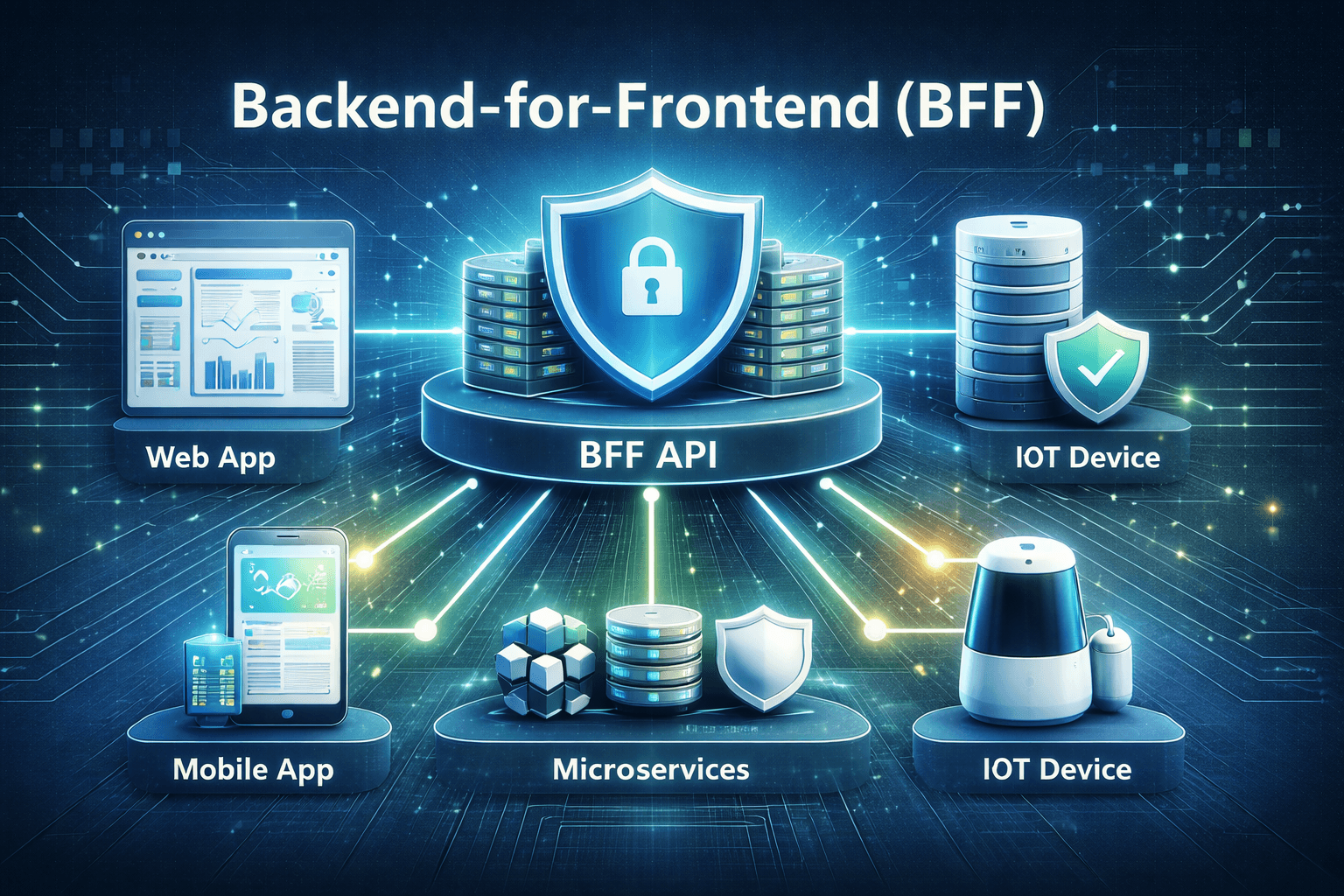
Backend-for-Frontend (BFF) is an architectural design that provides a specialized layer of the backend to every kind of user interface. Each UI, a mobile application or a web application, communicates to its own customized backend as opposed to all clients communicating to shared backend services. This BFF layer is an intermediary between the frontend and the microservices. It forms the information, performs business logic, implements security regulations, and optimizes answers to the exact requirements of the customer. In this way it simplifies the front end development and enhances the maintainability of systems. Essentially, BFF separates the front end requirements with no reference to backend implementation, which enables both sides to develop separately.
BFF in Microservices Architecture
Microservices systems divide applications into smaller independently deployable services. Although this method is better in scalability and resilience, it regularly leads to disjointed data sources and intricate communication patterns. Frontend clients might be required to make several API calls to get all the necessary information, which adds latency and network overhead. BFF pattern will solve this problem by making communication consolidated. The frontend does not make multiple calls to different services but makes a call to only one BFF endpoint. The BFF then makes communication with the corresponding microservices and provides a single response. This strategy simplifies the frontend logic, performance is enhanced and the back-end teams can optimize services without impacting on the client applications.
Enhancing Security Through BFF
BFF model is one of the best tools that lead to system security. The BFF layer restricts the internal services to be exposed straight to clients by serving as a regulated entry point.
Security benefits include:
- Single centralized authentication and authorisation: BFF is able to impose uniform security policies to individual UIs.
- Reduced attack surface: The internal microservices are not directly exposed to the clients.
- More effective validation and sanitization: Background validation and sanitization are possible prior to reaching backend services.
- Granular access control: This is the ability to limit different clients to certain operations or data views.
These capabilities allow organizations to implement security strategies more effectively while maintaining flexibility across platforms.
Performance and User Experience Improvements
User satisfaction is a major element in performance and it is particularly applicable when using mobile applications that have limited network and battery capabilities. BFF makes the best use of available resources by ensuring that there are no redundant data transmission and round tripping calls. Since each BFF is interface specific, it is only able to provide the data needed by this interface. This saves on the payload size and processing overhead and leads to response time is faster and responsiveness is enhanced. For mobile users, this translates into smoother interactions, reduced battery consumption, and a more reliable application experience.
Developer Productivity and Maintainability
In terms of development, BFF has a great increase in productivity. The frontend developers are no longer required to undertake complicated service coordination or business logic consolidation. At least, they communicate with a simplified and predictable API. It is also helpful to the backup teams. Back-end technology Backend services can be changed without affecting frontend clients provided the BFF contract is stable. This separation of concerns underpins an agile development, continuous integration, and independent team processes. Moreover, BFF leads to cleaner code bases as well as easier testing since the responsibility of each layer is well defined.
Use Cases and Practical Applications
The BFF model is especially useful in the setting in which several interfaces can use the same backend systems. Common use cases include:
- Various data formats and performance optimizations in mobile and web applications.
- Applications that have different security needs based on different clients.
- Microservice-based and API gateway cloud-native platforms.
- Systems, which combine legacy services with new frontends.
BFF will be flexible and scalable in such situations, and it will change in line with the changing business requirements.
Challenges and Considerations
Although BFF has advantages, it still has its challenges. The addition of more layers raises complexity in architecture and needs to be handled. Every BFF has to be kept, protected, and watched which can raise overheads in operations. Organizations should also make sure that BFFs do not stretch excessively their business logic between layers. Determinable design rules and service ownership are necessary to prevent problems of maintenance.
Test Your Knowledge!
Click the button below to generate an AI-powered quiz based on this article.
Did you enjoy this article?
Show your appreciation by giving it a like!
Conversation (0)
Cite This Article
Generating...