Technology
Beyond the Password: Why Self-Sovereign Identity (SSI) is the Future of Online Trust
Introduction
Think about your physical wallet for a second. Inside, you probably have a driver’s license, maybe a university ID, or a healthcare card. When a police officer asks for your license, you pull it out and show it. You hold the card. You control who sees it. You don't need to call the Department of Motor Vehicles every time you need to prove you can drive.
Now, think about your digital life. It’s the complete opposite.
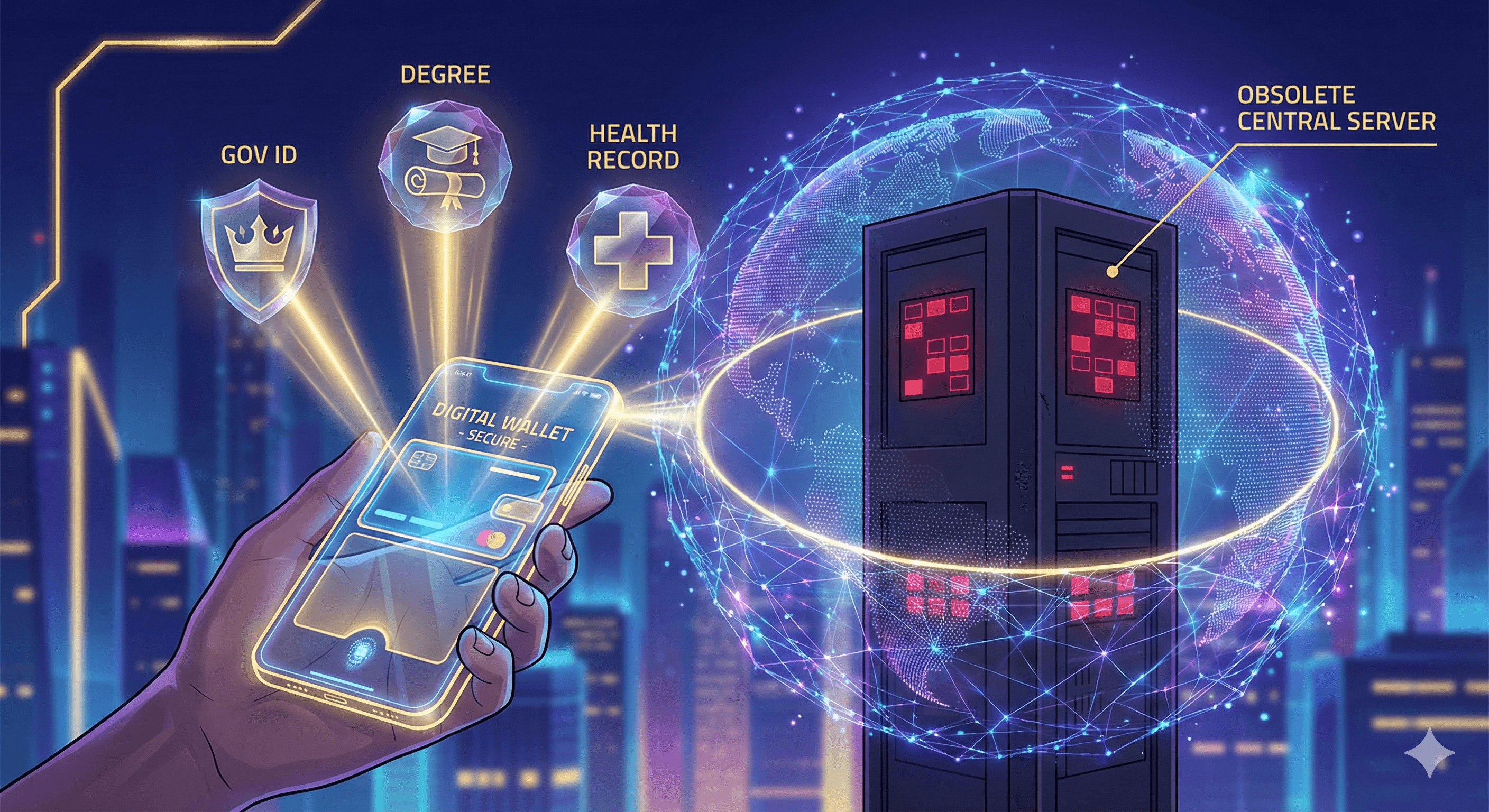
To prove who we are online, we rely on dozens of usernames and passwords scattered across the web. Or worse, we use "Log in with Facebook" or "Log in with Google," effectively handing the keys to our digital existence over to tech giants. In the current digital ecosystem, we don’t own our identity we rent it from centralized authorities.
But what if the internet worked like your physical wallet? What if you were the sole custodian of your personal data? This isn't just a futuristic theory. it's a rapidly evolving paradigm shift known as Decentralized Digital Identity, or often referred to in research circles as Self-Sovereign Identity (SSI).
It’s time we explored why the old model of identity is broken and how SSI is rebuilding trust on the internet.
The Deep Flaw in Centralized Identity
For decades, the internet was built without a native identity layer. We patched it up by creating silos. Your bank has one version of you, Amazon has another, and your social media has a third.
Research into cybersecurity consistently points to a critical failure in this model: the "honeypot" problem. When organizations hoard massive amounts of user data in centralized servers, they create irresistible targets for hackers. We see the results in the news almost weekly millions of credentials stolen in a single breach.
Furthermore, researchers arguing for digital human rights point out a fundamental lack of autonomy. When you rely on a third party to verify who you are, they have the power to revoke that identity at any time. You are not a digital citizen; you are a digital sharecropper living on someone else's land.
Enter Self-Sovereign Identity (SSI) Flipping the Script
SSI is a complex technological stack, often involving blockchains or distributed ledgers, but its philosophy is incredibly simple: You should be the central authority of you.
Based on foundational principles outlined in major academic and technical papers ( like the Christopher Allen's "Ten Principles of SSI" ), this new model shifts control from institutions back to the individual.
Here is the simplified mechanics of how it works, often described as the "Trust Triangle"
The Issuer: An organization (like a university or a government) attests to a fact about you. They cryptographically sign a digital "certificate" for example, "This person holds a B.Sc. degree." This is called a Verifiable Credential (VC).
The Holder (You): Instead of the university storing this fact on their server forever, they give the VC to you. You store it in a secure Digital Identity Wallet on your phone. It’s yours now.
The Verifier: Later, when applying for a job, an employer (the verifier) asks if you have a degree. You open your wallet and present that Verifiable Credential. The employer’s systems can instantly check the cryptographic signature on the blockchain to see that it was issued by a legitimate university and hasn't been tampered with.
Crucially, the university doesn't need to know where you showed your degree. The loop is closed without constant surveillance.
Privacy by Design: The Magic of Zero-Knowledge Proofs
One of the most exciting aspects covered in recent cryptographic research related to SSI is the concept of "Zero-Knowledge Proofs" (ZKPs).
In the old world, to enter a bar, you hand over your ID card. The bouncer sees your name, address, and exact date of birth, just to check if you are over 21. That's too much data leakage.
With SSI and ZKPs, you could prove to a website that you are "over 21" without revealing your actual date of birth. The technology allows you to prove a statement is true without revealing the underlying data used to prove it. This is a massive leap forward for digital privacy.
The Road Ahead: Challenges and Reality
While the academic and technical groundwork for SSI is robust, moving from theory to mass adoption is hard.
The biggest hurdle right now isn’t technology; it’s usability. Managing your own cryptographic keys is daunting for the average user. If you lose your physical wallet, it's a hassle. If you lose access to your digital identity wallet without proper backup mechanisms, it could be catastrophic. Research is currently heavily focused on "key recovery" mechanisms that are secure yet user-friendly (like "social recovery," where friends can help you regain access).
Furthermore, we need global standards. Governments and corporations need to agree on common frameworks (like the W3C Decentralized Identifier standards) so your digital ID works everywhere, from Tokyo to Toronto.
Conclusion
Decentralized Digital Identity isn't just another tech buzzword like NFTs or the Metaverse. It is fundamental infrastructure plumbing that the internet desperately needs.
It represents a maturation of the digital space—a move away from the "Wild West" where corporations claim ownership of our data, toward a structured society where individuals have rights, responsibilities, and control over their own digital selves. It won't happen overnight, but the transition to a user-centric internet has already begun.
Test Your Knowledge!
Click the button below to generate an AI-powered quiz based on this article.
Did you enjoy this article?
Show your appreciation by giving it a like!
Conversation (0)
Cite This Article
Generating...