Science
Connectivism Learning Theory: Learning in a Networked Digital World
“Knowledge has many authors, knowledge has many facets, it is a way of relating to something.” — Stephen Downes
Introduction: Learning in the Age of Constant Connectivity
Learning in the twenty-first century looks radically different from learning even two decades ago. Students no longer depend solely on textbooks, libraries, or teachers as their primary sources of information. Instead, knowledge is accessed instantly through search engines, artificial intelligence assistants, social media platforms, online communities, and digital databases. Smartphones, laptops, and cloud-based tools have become everyday learning companions. As a result, the way knowledge is acquired, evaluated, and applied has fundamentally changed.
Traditional learning theories—behaviorism, cognitivism, and constructivism—were developed in eras when information was scarce, relatively stable, and institutionally controlled. In contrast, modern learners operate in an environment where information is abundant, rapidly evolving, and distributed across digital networks. To address this shift, connectivism emerged as a learning theory that attempts to explain how learning occurs in a technology-driven, networked world. Connectivism was proposed to address this gap, offering a framework for understanding learning in digitally networked environments.
This article explores the foundations of connectivism, its key principles, practical classroom applications, strengths and criticisms, and its place among established learning theories.
What Is Connectivism Learning Theory?
Connectivism is a contemporary learning theory that views learning as a process of forming and navigating networks of information, people, and digital tools. Rather than locating knowledge solely within an individual’s mind, connectivism argues that learning exists across connections—both human and non-human. Knowing where to find information can be just as important as knowing the information itself.
According to connectivism, learners are not passive recipients of knowledge. Instead, they actively create meaning by linking ideas, resources, and perspectives from multiple sources. Learning occurs through participation in online communities, social media, blogs, databases, learning management systems, and artificial intelligence tools. In this framework, technology is not merely a delivery medium but an integral part of cognition.
Origins and Development of Connectivism
Connectivism was formally introduced in the mid-2000s by George Siemens and Stephen Downes. Siemens’ influential paper Connectivism: Learning as Network Creation and Downes’ work on connective knowledge laid the theoretical groundwork for this approach. Both scholars argued that existing learning theories were insufficient to explain learning in digitally mediated environments.
While Siemens emphasized the social and organizational dimensions of learning networks, Downes focused more on non-human agents, such as algorithms and machine learning systems, as contributors to knowledge creation. Together, their work highlighted how learning extends beyond the individual to include systems, technologies, and collective intelligence.
Nodes and Links: The Architecture of Learning
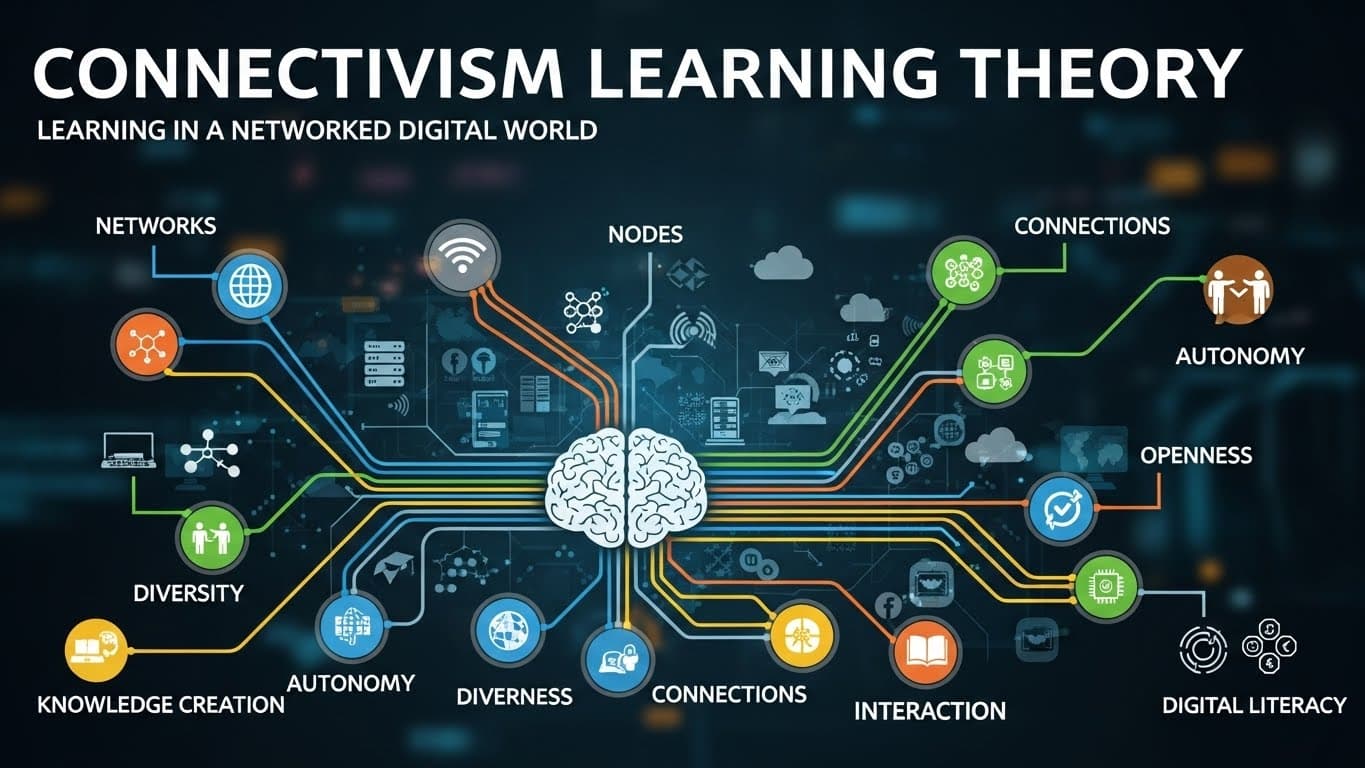
A core metaphor in connectivism is that of networks, composed of nodes and links.
-
Nodes represent sources of information or entities that store knowledge. These can include people, books, websites, databases, artificial intelligence systems, or even organizations.
-
Links are the connections between nodes, enabling information to flow, combine, and evolve.
Learning occurs when individuals create, strengthen, and maintain meaningful connections between nodes. Over time, learners themselves become nodes within larger networks, contributing knowledge back into the system. This dynamic process reflects the constantly changing nature of knowledge in digital environments.
Principles of Connectivism
Connectivism is guided by several foundational principles that distinguish it from earlier learning theories:
1. Knowledge rests in diversity of opinions Learning benefits from exposure to multiple perspectives rather than a single authoritative source.
2.Learning is a process of connecting specialized nodes Understanding emerges through linking information across disciplines, platforms, and communities.
3. Learning may reside in non-human appliances Databases, algorithms, and digital tools store and process knowledge independently of human memory.
4.The capacity to know more is more critical than what is currently known Adaptability and continuous learning are essential in fast-changing environments.
5.Nurturing connections is necessary for lifelong learning Learning is ongoing and depends on maintaining active networks.
6.The ability to recognize patterns and connections is a core skill Learners must evaluate relevance, credibility, and relationships between ideas.
7.Up-to-date knowledge is the goal of learning Accuracy and currency matter more than static mastery.
8.Decision-making is itself a learning process What is correct today may become outdated tomorrow, requiring constant reassessment.
These principles collectively describe learning as adaptive, distributed, and network-dependent.
Connectivism in Practice: The Classroom and Beyond
These principles translate directly into how learning environments are designed and experienced. Implementing connectivism involves rethinking traditional roles in education. Rather than acting as the sole source of knowledge, educators become facilitators of learning networks, helping students develop the skills needed to navigate, evaluate, and contribute to information ecosystems.
Digital Learning Environments
Online courses, webinars, learning management systems, and massive open online courses (MOOCs) provide learners with access to global knowledge networks. Students engage with content, peers, and experts across geographical boundaries.
Social Media as Learning Spaces
Platforms such as discussion forums, blogs, and professional networking sites allow learners to share insights, debate ideas, and co-construct knowledge. These interactions mirror real-world professional learning communities.
Simulations and Virtual Learning
Simulations, virtual labs, and immersive environments support experiential learning by allowing students to test ideas and observe outcomes in safe, controlled settings.
Gamification and Adaptive Tools
Educational applications that incorporate feedback, progression, and adaptive challenges encourage sustained engagement and personalized learning pathways.
Through these approaches, learners gain autonomy over what, how, and when they learn, while educators guide the process strategically.
Strengths of Connectivism
-
Connectivism offers several advantages in contemporary education:
-
Relevance to digital learners: It reflects how students already interact with information in everyday life.
-
Support for lifelong learning: Emphasizes adaptability and continuous skill development.
-
Collaboration and diversity: Encourages collective intelligence and exposure to varied viewpoints.
-
Empowerment of learners: Shifts responsibility toward self-directed learning and critical evaluation.
Criticisms and Limitations
Despite its relevance, connectivism has been challenged on both theoretical and practical grounds.
Is It a Learning Theory?
Some scholars argue that connectivism is better described as an instructional or pedagogical framework rather than a standalone learning theory. This critique is strongest when connectivism is treated as a replacement for established theories rather than a meta-framework for digital learning. Critics claim it lacks sufficient empirical grounding compared to established theories.
Cognitive Depth
Others suggest that connectivism underemphasizes internal cognitive processes, focusing more on access to information than deep understanding. This limitation becomes most apparent in learning tasks that require deep conceptual understanding rather than information navigation.
Equity and Access
Effective connectivist learning depends on access to technology and digital literacy, which may disadvantage learners in resource-limited contexts.
Guidance vs. Autonomy
Without sufficient scaffolding, learners may become overwhelmed by information overload, highlighting the need for structured support alongside networked learning.
Connectivism Compared to Other Learning Theories
-
Behaviorism focuses on observable behavior shaped by reinforcement, whereas connectivism emphasizes distributed knowledge and network participation.
-
Cognitivism centers on mental processes and memory, while connectivism recognizes that cognition can be externalized through technology.
-
Constructivism highlights meaning-making through experience and social interaction; connectivism extends this idea by embedding learning within digital and technological networks.
Rather than replacing these theories, connectivism complements them by addressing learning in environments shaped by rapid technological change. Comparing connectivism with earlier theories highlights what it adds rather than what it replaces.
The Future of Learning in a Connected World
As artificial intelligence, data analytics, and immersive technologies continue to evolve, learning will become increasingly networked, adaptive, and decentralized. Connectivism provides a valuable lens for understanding how learners interact with knowledge ecosystems that are complex, dynamic, and collaborative.
The challenge for educators lies in balancing openness with structure—empowering learners to explore networks while providing guidance to ensure depth, accuracy, and ethical engagement. When applied thoughtfully, connectivism supports not only academic success but also the development of critical digital citizenship skills essential for modern life.
Conclusion
Connectivism reflects the realities of learning in a digital age where information is abundant, rapidly changing, and socially distributed. By framing learning as a process of connecting nodes within dynamic networks, it captures dimensions of education that traditional theories struggle to explain. While not without limitations, connectivism offers powerful insights into how learners acquire, evaluate, and apply knowledge in contemporary contexts.
In an era defined by connectivity, learning is no longer confined to classrooms or minds—it lives in the networks we build, maintain, and transform.
References
- Bell, F. (2011). Connectivism: Its place in theory-informed research and innovation in technology-enabled learning. International Review of Research in Open and Distributed Learning, 12(3), 98–118. https://doi.org/10.19173/irrodl.v12i3.902
- Clark, A., & Chalmers, D. (1998). The extended mind. Analysis, 58(1), 7–19. https://doi.org/10.1093/analys/58.1.7
- Downes, S. (2005). An introduction to connective knowledge. Retrieved December 22, 2005, from https://www.downes.ca/post/33034
- Downes, S. (2007, February 3). What connectivism is. Half an Hour. Retrieved from https://halfanhour.blogspot.com/2007/02/what-connectivism-is.html
- Downes, S. (2012). Connectivism and connective knowledge: Essays on meaning and learning networks. National Research Council Canada. Retrieved from OER Knowledge Cloud PDF
- Illeris, K. (2018). Contemporary theories of learning: Learning theorists in their own words (2nd ed.). Routledge. Taylor & Francis
- Kop, R., & Hill, A. (2008). Connectivism: Learning theory of the future or vestige of the past? International Review of Research in Open and Distributed Learning, 9(3). https://doi.org/10.19173/irrodl.v9i3.523
- Laurillard, D. (2012). Teaching as a design science: Building pedagogical patterns for learning and technology. Routledge. Taylor & Francis
- Luckin, R., Holmes, W., Griffiths, M., & Forcier, L. B. (2016). Intelligence unleashed: An argument for AI in education. Pearson. Retrieved from Pearson PDF
- Salmon, G. (2013). E-tivities: The key to active online learning (2nd ed.). Routledge. Routledge catalog
- Schunk, D. H. (2020). Learning theories: An educational perspective (8th ed.). Pearson. Pearson Higher Ed
- Siemens, G. (2005). Connectivism: A learning theory for the digital age. International Journal of Instructional Technology and Distance Learning, 2(1), 3–10. Retrieved from edtechpolicy.org PDF
- Siemens, G. (2006). Knowing knowledge. Lulu Press. Retrieved from Internet Archive
- Siemens, G., & Downes, S. (2008). Connectivism & connected knowledge. University of Manitoba. Retrieved from Downes.ca course slides
Test Your Knowledge!
Click the button below to generate an AI-powered quiz based on this article.
Did you enjoy this article?
Show your appreciation by giving it a like!
Conversation (0)
Cite This Article
Generating...