Engineering
The Airbus A330 Series: Versatility Reimagined
Introduction
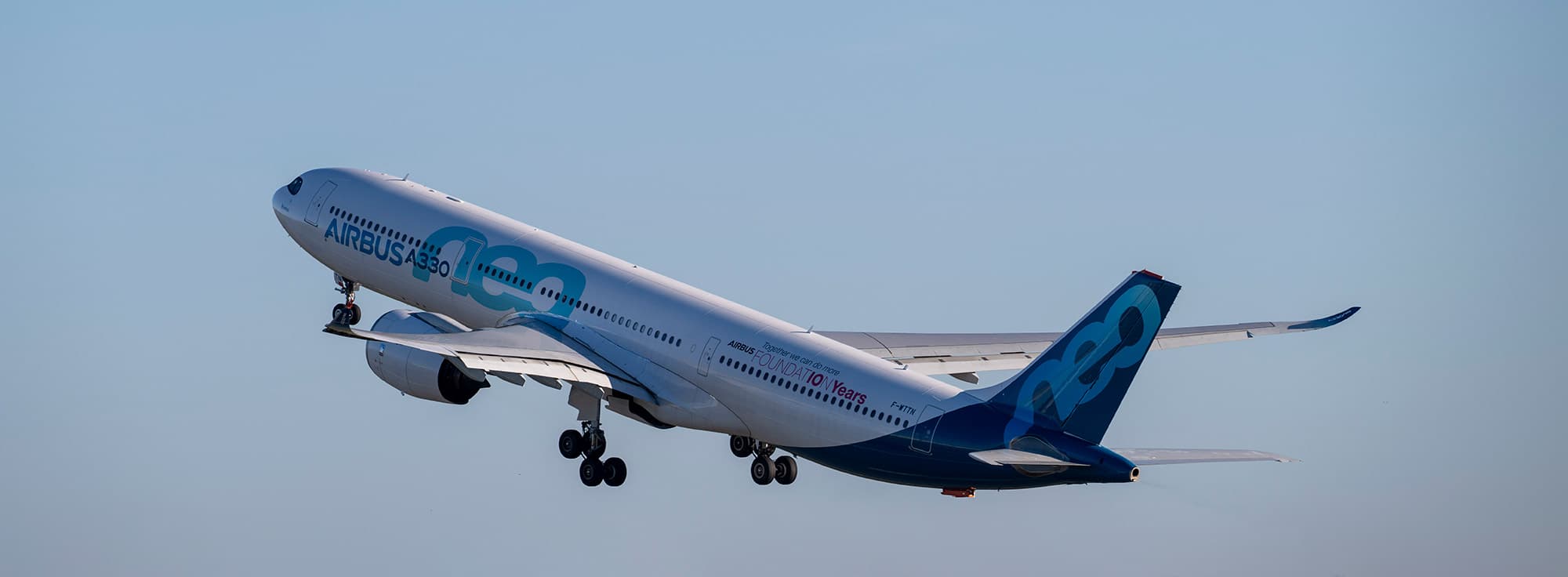
The A330 family is a highly versatile platform that has evolved over three decades. It is divided into two main generations: the original A330ceo (Current Engine Option) and the next-generation A330neo (New Engine Option). For students of engineering, the A330 is a study in "Incremental Innovation"—where an already successful airframe is continuously upgraded with new materials, aerodynamic sharklets, and high-bypass turbofan engines to remain competitive against newer designs like the Boeing 787.
The A330ceo Generation (Classic)
The "ceo" versions are the backbone of many global airlines, offering a proven, low-risk solution for medium-to-long-haul missions.
A330-200: The Long-Range Specialist
- Engineering Goal: Designed with a shorter fuselage to reduce weight and increase fuel capacity for longer routes.
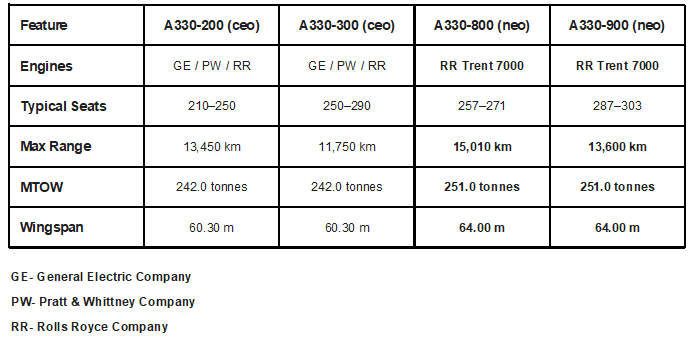
- Typical Seating: 210 to 250 passengers.
- Max Range: ~13,450 km (7,250 nm).
A330-300: The High-Capacity Workhorse
- Engineering Goal: A "stretched" version of the -200, optimized for high-density routes where passenger volume is more important than extreme range.
- Typical Seating: 250 to 290 passengers.
- Max Range: ~11,750 km (6,350 nm).
The A330neo Generation (Modern)
Launched in 2014, the A330neo family incorporates advanced technologies from the Airbus A350, including a new high-span wing and Rolls-Royce Trent 7000 engines. These upgrades result in a 25% reduction in fuel burn and CO2 emissions per seat compared to previous-generation competitors.
A330-800: The Performance Leader
- Fuselage Length: 58.36 meters.
- Typical Seating: 257 to 271 passengers.
- Max Range: 15,010 km (8,105 nm).
- Max Take-Off Weight (MTOW): 251.00 tonnes.
- Fuel Capacity: 139,090 Liters.
A330-900: The Efficiency Leader
- Fuselage Length: 63.69 meters.
- Typical Seating: 287 to 303 passengers.
- Max Range: 13,600 km (7,350 nm).
- Max Take-Off Weight (MTOW): 251.00 tonnes (with a 253t taxi weight option).
- Fuel Capacity: 139,090 Liters.
Specialized Variants: Cargo and Military
A330-200F (Freighter) This is a dedicated mid-size freighter designed to carry a 70-tonne payload over a range of 7,400 km.
- Unique Engineering: To ensure the cargo floor remains perfectly horizontal during loading, Airbus added a "bulge" under the nose to accommodate a revised landing gear, as the standard A330 sits at a slight nose-down angle.
A330 MRTT (Multi Role Tanker Transport) Widely considered the most capable tanker in service, the MRTT can act as a refueler, a passenger transport (up to 300 pax), or a medical evacuation (MedEvac) unit.
- Fuel Offload: It can offload up to 111,000 kg of fuel using its "Boom" or "Probe and Drogue" systems.
Comparison Table (Passenger Variants)
Bibliography
Official Specifications:
- Airbus (2026). A330-800: Technical Data. [online] Available at: aircraft.airbus.com [Accessed 30 Jan. 2026].
- Airbus (2026). A330-900: Technical Data. [online] Available at: aircraft.airbus.com [Accessed 30 Jan. 2026].
- Airbus (2025). Airbus-A330-Facts-and-Figures- April 2025.
Operational Analysis:
- Simple Flying (2026). Why The Airbus A330 Won’t Be Retired Anytime Soon.
- Airbus Defence (2026). A330 MRTT Overview.
Test Your Knowledge!
Click the button below to generate an AI-powered quiz based on this article.
Did you enjoy this article?
Show your appreciation by giving it a like!
Conversation (0)
Cite This Article
Generating...