Science
How Virtual Reality (VR) and Augmented Reality (AR) Are Transforming Human Anatomy Education
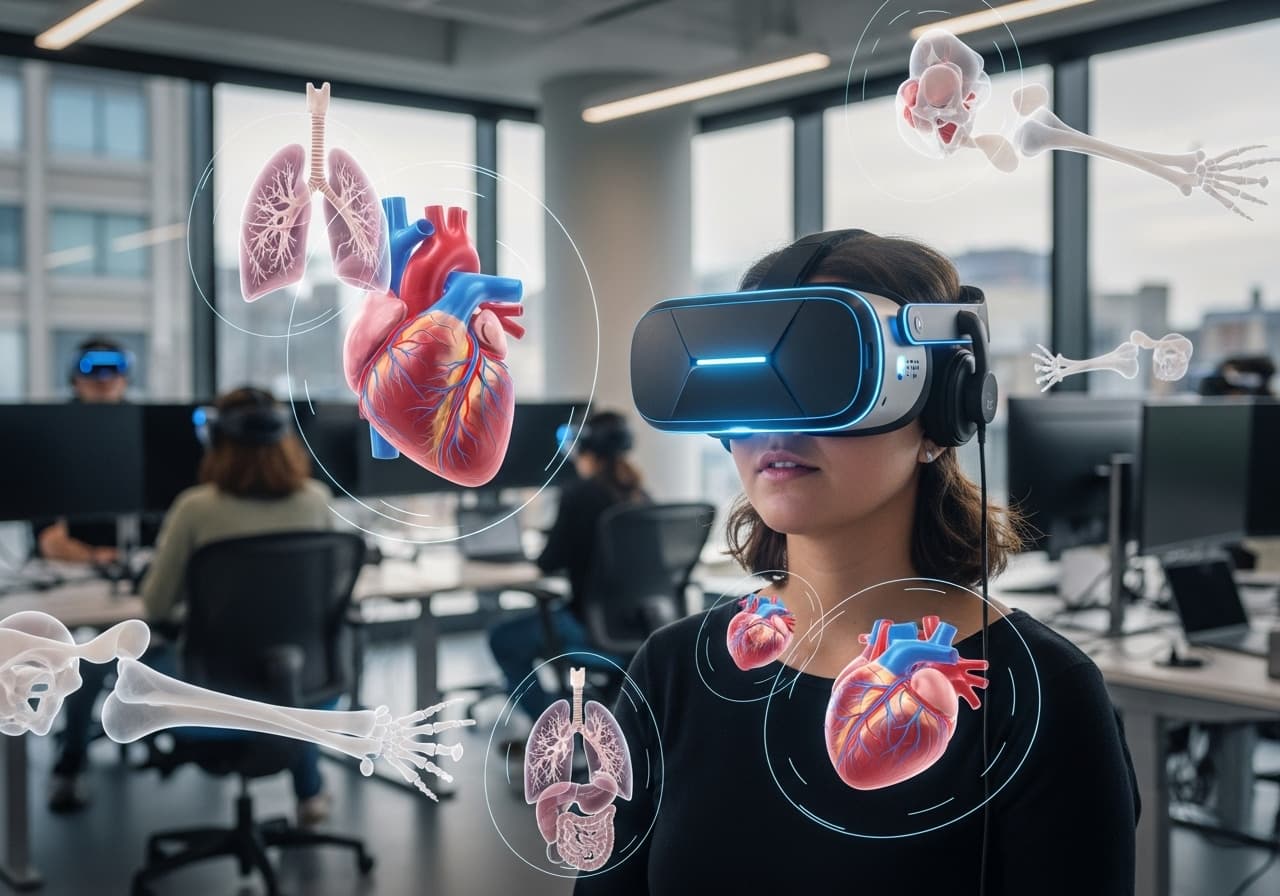
Advances in technology are revolutionizing how we learn and understand human anatomy. Virtual Reality (VR) and Augmented Reality (AR) are at the forefront of this transformation, offering immersive and interactive learning experiences that have the potential to surpass traditional methods of teaching anatomy.
Traditionally, anatomy education relied heavily on textbooks, 2D illustrations, and dissections using cadavers. While these methods have provided foundational knowledge, they often fall short in conveying the complex three-dimensional relationships between anatomical structures. VR and AR technologies address these limitations by creating detailed, three-dimensional models that learners can explore from multiple angles, deepening their understanding and engagement (Niu, 2025).
VR offers fully immersive experiences where students can virtually step inside the human body, examining organs, tissues, and systems in a stereoscopic and highly detailed manner. This can significantly improve spatial awareness and retention of anatomical knowledge. For example, studies have shown that students using VR demonstrated better understanding of complex structures like the vascular system and nervous pathways compared to traditional study methods (Adnan, 2025).
AR adds another layer of interactivity by overlaying digital information onto the real world. A student can, for instance, use AR glasses or tablets to see a 3D model of an organ hovering over a physical specimen or body part, which helps in correlating textbook diagrams with real anatomy. This technology not only enhances engagement but also facilitates hands-on learning, especially in resource limited settings where access to cadavers or advanced lab equipment is limited (Esmaeeli, 2025).
The adoption of VR and AR in anatomy training aligns with modern pedagogical approaches that emphasize experiential learning. These technologies encourage active exploration and self-guided discovery, which are essential components of effective education. They also provide safe, scalable, and repeatable experiences, allowing students to practice complex procedures and understandings without the ethical and logistical issues associated with dissection or cadaver use (Abundez Toledo et al., 2025).
Recent research supports the effectiveness of VR and AR in improving student learning outcomes. Comparative studies indicate that students using VR and AR tools perform better in anatomy tests and develop a deeper understanding of spatial relationships within the human body than those relying solely on traditional methods (Wang et al., 2024).
Furthermore, these technologies have the potential to democratize anatomy education by making high-quality learning tools accessible in low-resource environments. With affordable VR headsets and AR applications, students worldwide can access detailed anatomical models and simulations, fostering global improvements in health education (Martín-Valero, 2025).
In conclusion, VR and AR are transforming anatomy education by making learning more engaging, effective, and accessible. As these technologies continue to evolve, they promise to become standard tools in medical curricula, helping future healthcare professionals develop a comprehensive and intuitive understanding of the human body.
Test Your Knowledge!
Click the button below to generate an AI-powered quiz based on this article.
Did you enjoy this article?
Show your appreciation by giving it a like!
Conversation (0)
Cite This Article
Generating...