Technology
Kotlin Multiplatform Mobile (KMM): The Future of Cross-Platform Native Development
Introduction
The mobile application ecosystem is growing at a very fast rate with businesses trying to offer high quality experiences on both Android and IOS applications. Conventionally, companies have had a thorny decision to make between creating individual native applications per platform or making cross-platform frameworks compromising performance and platform integration. Kotlin Multiplatform Mobile (KMM) has become a current solution that fills this gap and enables developers to share common logic but still have the maximum potential of native development. KMM is an emerging technology of the cross-platform that is aimed at making it efficient, performance-based, and flexible. KMM allows sharing of code where it is logical, and still supports native user interfaces and platform-specific functionality, unlike other frameworks that require developers to create a single shared framework that they must use to create the entire application. This strategy renders KMM a good prospect of the future of mobile development.
The Evolution of Cross-Platform Development
The cross-platform development has been an objective long time aiming at decreasing the development time and its cost, and the complexity of its maintenance. Conventional methods meant these codebases were different in Android and iOS and thus created duplicated efforts and inconsistent behavior across systems. To address this, several cross-platform frameworks came up, in a bid to enable developers write one and run it anywhere. Most of these frameworks, however, presented some restriction like lower performance, limited access to native APIs, and irregular user experience. In most cases developers were faced with a choice between productivity and native performance. A more balanced approach is introduced by Kotlin Multiplatform Mobile. It does not replace native development, but complements it by making it possible to share common logic without compromising native performance and end user experience. This allows the benefits of the native development and cross-platform to be merged.
What is Kotlin Multiplatform Mobile (KMM)?
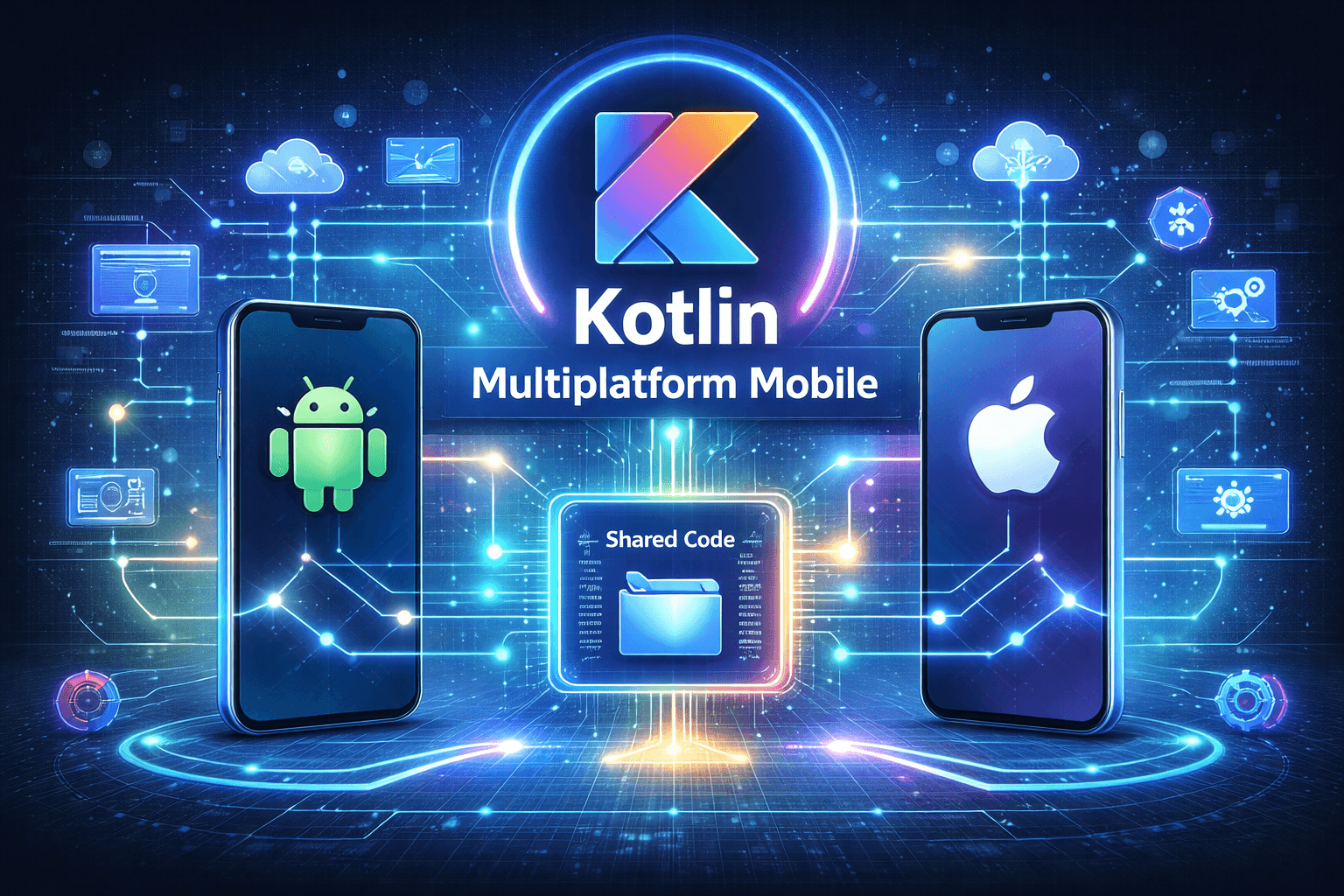
Kotlin Multiplatform Mobile is a cross-platform software development technology, which enables a developer to create a shared code in Kotlin and reuse it on various platforms, especially Android and iOS. The common code normally contains business logic, networking, data handling, and application core functionality. KMM does not substitute native development as with the traditional cross-platform solutions. Rather, the developers create platform-specific user interfaces with platform-specific tools like SwiftUI on iOS and Jetpack Compose or XML on Android. The core logic is done in the common Kotlin code and the user interface and platform specifics in the native layer. This architecture is such that applications are not held back within the system but instead they receive native performance and responsiveness without shared development efficiency being compromised. KMM is flexible in the sense that it ensures the developer can determine the level of code to share and how much to make platform-specific.
How KMM Works: Architecture Overview
KMM follows a modular architecture that separates shared logic from platform-specific implementations. The architecture typically includes: Shared Module: This contains common business logic such as data processing, networking, authentication, and application rules. This code is written in Kotlin and compiled for multiple platforms. Platform-Specific Modules: These modules contain code specific to Android and iOS, including user interface design, hardware integration, and platform-specific features. Native UI Layer: Each platform maintains its own native user interface, ensuring optimal performance and user experience. This modular approach improves maintainability, scalability, and development efficiency while preserving platform independence.
Key Benefits of Kotlin Multiplatform Mobile
1. Code Reusability - A major benefit of KMM is the possibility to reuse a major part of application logic across platforms. This minimizes duplication, enhances consistency and develops fast. In core functionality developers can write once and run it on both Android and iOS and business logic can be the same across the platforms.
2. Native Performance - As opposed to hybrid frameworks, KMM enables native applications on each platform. The common code is packaged into native binaries, thus making it fast and responsive. It implies that developers do not need to sacrifice performance in favor of reusing the code.
3. Flexibility and Control - KMM gives control to the developers on platform features. They can go native, access hardware capabilities, and tools that are platform-specific. The same flexibility will enable developers to create highly optimized and completely native applications yet still enjoy the benefits of shared code.
4. Improved Developer Productivity - KMM enhances the productivity of developers by eliminating redundant code and making the maintenance of the code easier. Instead of having separate implementations maintaining, development teams can concentrate on writing core functionality. This further reduces testing and debugging since the shared logic can be tested once.
5. Easier Maintenance and Scalability - Keeping distinct codebases may be costly and inaccurate. KMM makes maintenance easier through centralization of shared logic. When a change is needed, the developers are only required to make changes to the shared module as opposed to having to make changes to each individual platform.
Real-World Applications of KMM
KMM is especially applicable in those applications which need the same functionality over the platforms. Common use cases include:
- Enterprise applications
- Banking and financial applications.
- E-commerce platforms
- Healthcare applications
- Productiveness and collaboration tools.
There is usually a need in these applications to have uniform business logic, data protection and platform performance. KMM helps organizations to implement credible and scalable mobile applications and minimise the development effort.
Challenges and Considerations
Despite its advantages, KMM also introduces some challenges:
- Learning Curve - velopers must understand both Kotlin and native development environments such as Swift and Android SDK.
- Initial Setup Complexity - Setting up a multiplatform project may be more complex compared to single - platform development.
- Tooling and Ecosystem Maturity - Although rapidly improving, the KMM ecosystem is still evolving.
Why KMM Represents the Future of Mobile Development
Several trends indicate that KMM will play a major role in the future of mobile development:
- Growing demand for cross-platform solutions - Organizations want faster development without sacrificing quality.
- Need for native performance - Applications require high performance, security, and reliability.
- Modern Kotlin ecosystem - Kotlin has become a preferred language for Android and is increasingly used in backend and multiplatform development.
- Scalable architecture support - KMM integrates well with modern software architectures and cloud-based systems.
Conclusion
Kotlin Multiplatform Mobile is a significant breakthrough in the cross-platform mobile development. It provides the optimal tradeoff between code sharing and native performance, allowing developers to share business logic and use native user interfaces. KMM offers a potent solution to a current-day mobile application development by minimizing the development time, enhancing its consistency, and maintaining the performance. It is the best choice because it has a flexible architecture, performs well and has a developing ecosystem that is suitable to organizations aiming to develop scalable, secure, and quality applications. With the ever-increasing complexity and demand of mobile applications, Kotlin Multiplatform Mobile stands to be one of the most important technologies that is going to define the future of the cross-platform native application development.
Test Your Knowledge!
Click the button below to generate an AI-powered quiz based on this article.
Did you enjoy this article?
Show your appreciation by giving it a like!
Conversation (0)
Cite This Article
Generating...