Technology
SQL vs. NoSQL vs. NewSQL
SQL vs. NoSQL vs. NewSQL - The Battle for Your Data
Data is the king of the world of Software Engineering but where do you put all the data?
For a long period of time the answer for the above question was - The Relational Database (SQL). After that the “Big Data Explosion" came up and the rule book was torn up by NoSQL. But now the new third player NewSQL claims to offer the best of both worlds.
Choosing the wrong database could impact your application’s performance or lead to data disasters. So let’s break down these three categories and storage then you can pick the right tool for your development.
- SQL - the “Old Reliable” (Relational)
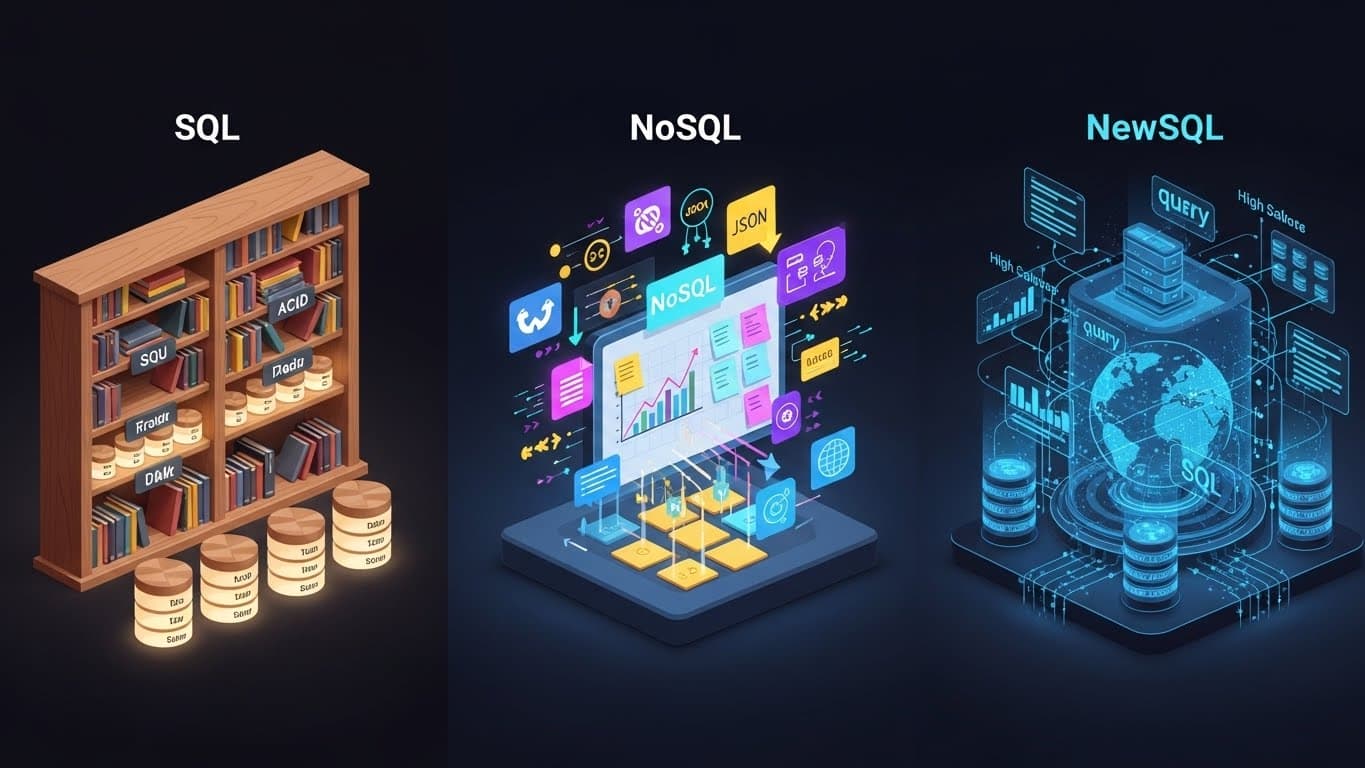
The industry standard SQL (Structured Query Language) databases are dated to the 1970s.Imagine that they are a Strict Librarian. The information is stored in inflexible tables consisting of rows and columns (similar to an Excel sheet). The Requirements: You have to specify your schema and then add data afterwards. Assuming one of the users has a Name, Age and Email, each of the records has to be of the same format. ACID Compliance is the super power of SQL. It ensures Durability, Atomicity, Isolation and Consistency. In case of failure of a transaction (such as bank transfer), the entire thing is reversed. No half-finished data. The Limit They scale up and down. A larger and costly server is needed to manage larger traffic. It is not so easy to simply add more small servers.
Examples - PostgreSQL, MySQL, Oracle. Best: Money, online shopping and any application in which data integrity is life and death.
- NoSQL - The “Flexible Rebel” (Non-Relational)
NoSQL (Not Only SQL) was created in the latter 2000s as a response to the disorder of Big Data. Imagery of this is as a Digital Sticky Note board. The structure is flexible. You may save data in Documents (JSON), Key-Value pairs or as Graphs. And there are no rules. You may add a Twitter Handle on one user and not the rest. There is no need to define a schema ahead of time. Scalability is the superpower of NoSQL. It scales horizontally. You simply add the more inexpensive servers to the cluster to process additional traffic. The Limit is typically trade-offs between high speed and high consistency (also known as "Eventual Consistency"). You will notice that your phone can display 99 likes and your laptop can display 100 likes in a few seconds. MongoDB, Cassandra, Redis. Best-used for Social media feeds, real time analysis, content management and Rapid prototyping.
- NewSQL - The “Super Hybrid”
NewSQL is the recent entrant. It tries to address the final trade-off: "Is it possible to achieve the rigor of SQL but the scalability of NoSQL? Imagine that NewSQL is a Dystopian Cybernetic Archive. The Promise is It appears and behaves like a conventional SQL database (the query language is standard SQL). It stores the ACID (causes your bank data to be safe). The Magic: Under the hood, it divides data among a big number of servers just like NoSQL. It horizontally scales but handles the complicated mathematics so that information is always fully consistent on all of those servers. The Trade-off is these systems are not only expensive to install, but also tend to be more costly to operate in comparison to a simple MySQL or MongoDB instance.
Examples CockroachDB, Google Spanner, VoltDB. Best: Apps that need to work across the globe with money or important inventory (e.g., Uber, global banking apps) and you require huge scale and no mistakes.
The Verdict - Which One Wins?
Either there isn’t a winner, there is an appropriate tool to your particular problem. Use SQL when you have a stable data structure and have data integrity as your primary concern (eg: Accounting software). NoSQL is best when your data is unstructured, dynamically changing, or when you have to make/write to millions of simple reads with writes per second (eg: A gaming leaderboard). Select NewSQL when you need to build the next Google or Uber and require it to scale with large scale all over the world with high precision of transactions.
Test Your Knowledge!
Click the button below to generate an AI-powered quiz based on this article.
Did you enjoy this article?
Show your appreciation by giving it a like!
Conversation (0)
Cite This Article
Generating...