Technology
Monolith vs. Microservices
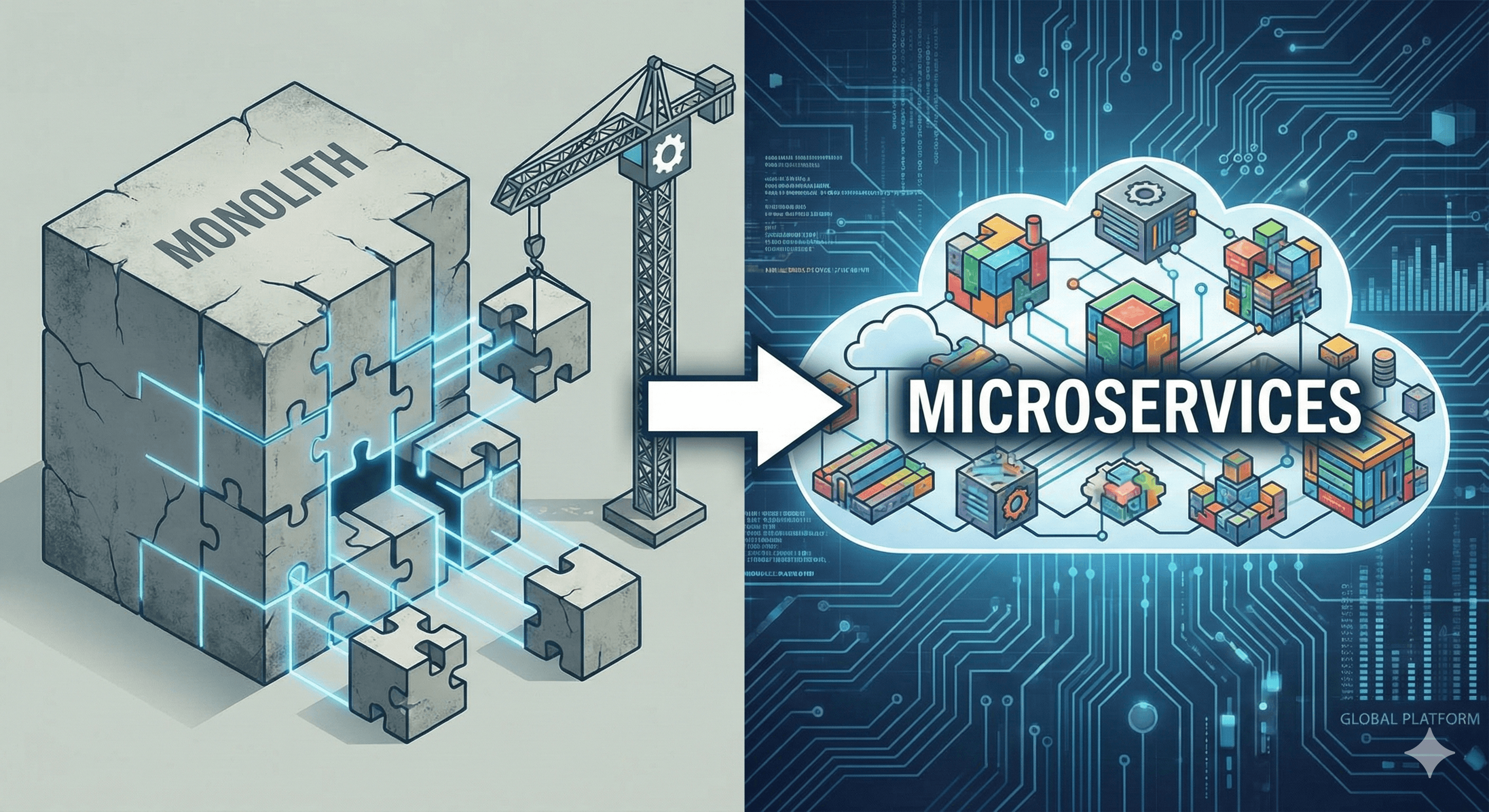
Monolith vs. Microservices Why All Your Favorite Apps Are Breaking Apart
You will likely have heard the stories. Such a startup as Netflix or Amazon may start as a mere site, and then evolve into a huge corporation. The thing is this: the application that you are using now is not what they began with. In order to sustain that expansion, they were forced to dismantle their initial applications.
It is no indicator of failure but one of the strongest engineering strategies. It is the account of a huge industry transformation of a Monolith architecture to a Microservice architecture. It is one of the most significant changes in our industry as a software engineer. Let's break it down.
What is a Monolith? (The "All-in-One")
The classic approach to application construction is a Monolith: a single, one-pound of codebase. There is a mishmash of the user interface, payment logic, and user profiles. Respondent: You have to test and deploy the whole application in order to make one small change.
This is easy to begin with, but it disintegrates with growth. One small bug can lead to a crash of the entire application. It makes the process of releasing updates slow and dangerous. And you have been chained up to a single technology stack. The most significant one is a question of scaling: when your video streaming functionality becomes popular, you have to scale the whole application, which is extremely inefficient and costly.
What are Microservices? (The "Breaking Apart")
This is the solution. A Microservice architecture divides the large application into a set of small, autonomous services.
A service is good at only one thing (e.g. a payment-service, a user-service). They can be deployed independently: it can be 50 times a day before the recommendations team will update their service and have an impact on the payment team. These services communicate because of a network (through APIs), but they are not mixed up.
- The Great "Why", Why They Fall Apart.
There are several reasons why companies switch to microservices that are critical and cause high impact
- Independent Scalability (The #1 Reason)
This is the holy grail. You scale only what you need. At times when the so-called payment-service has to work hard, it is possible to scale it to 100 servers, whereas the so-called user profile service remains at 5 only. This saves money and it is efficient.
- Team Autonomy and Speed
You can have small teams which are autonomous, rather than a big team; and own their service. They are able to build, release and expand their feature themselves which accelerates the speed of development immensely.
- Resilience (Fault Isolation)
In a monolith, when an aspect of the application fails, the entire app fails. When the microservice crash occurs, the remainder of the app will remain online, in a microservice world. Even down of one non-critical part does not prevent users to search and pay.
- Technological Freedom
The best technology that can be utilized in each service can be employed. The search service in python and the payment service in Java can be written with the best tool in doing the task.
The Trade-Off
Micro services are not ideal. They resolve the code complexity and introduce operational complexity. There are dozens of services to monitor, secure and connect now. The culture of a powerful DevOps that is based on automation is necessary.
Conclusion
Breaking apart apps is not anarchy: it is a planned rearrangement. The Monolith suits well with new projects and startups. However, the Microservice architecture is the solution in order to become a global, resilient, and rapidly-evolving platform. The modern web runs on the secret infrastructure.
Test Your Knowledge!
Click the button below to generate an AI-powered quiz based on this article.
Did you enjoy this article?
Show your appreciation by giving it a like!
Conversation (0)
Cite This Article
Generating...