Science
Ocean Fertilization: How Volcanoes Feed the Deep Sea
1.0 Introduction: The Paradox of the Volcano
We often view volcanic eruptions through the lens of destruction burning forests, buried cities, and ash-filled skies. However, when a volcano meets the sea, the story changes from one of death to one of profound creation. This phenomenon, known as Ocean Fertilization, is a critical, yet often overlooked, mechanism that sustains life in the most remote parts of our planet.
For STEM students and professionals, understanding this process requires a look into the "Biological Pump" of our oceans and how a single eruption can trigger a massive surge in the global food chain.
2.0 The Problem: Ocean "Deserts"
Large sections of the open ocean are essentially biological deserts. While there is plenty of sunlight and water, these areas lack Micronutrients specifically Iron (Fe) and Nitrate (NO3). Phytoplankton (microscopic plants) need iron to perform photosynthesis. Without it, they cannot grow, which means fish and whales have nothing to eat. This is where the volcano becomes the "Fertilizer Spread" of the earth.
2.1 What is Phytoplankton
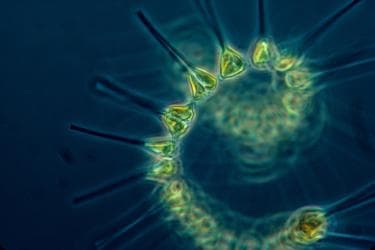
The two main classes of phytoplankton are dinoflagellates and diatoms. Dinoflagellates use a whip-like tail, or flagella, to move through the water and their bodies are covered with complex shells. Diatoms also have shells, but they are made of a different substance and their structure is rigid and made of interlocking parts. Diatoms do not rely on flagella to move through the water and instead rely on ocean currents to travel through the water.
3.0 The Science of the "Flash Fertilizer"
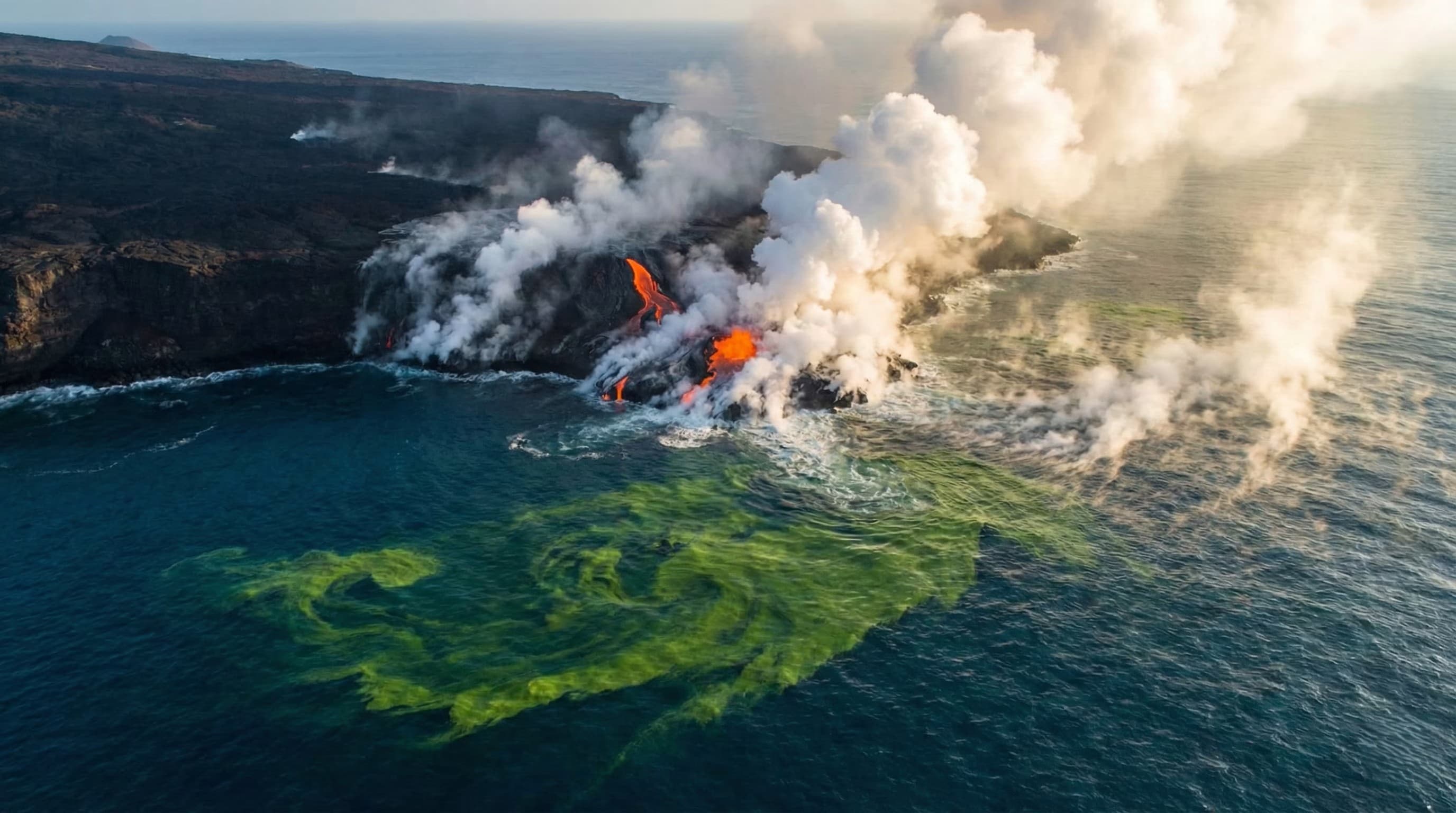
When lava enters the ocean as seen in the dramatic "lava entries" of Hawaii’s Kilauea or underwater eruptions a violent chemical and physical reaction occurs.
3.1 Rapid Quenching and Glass Formation
As 1200 Celcius lava hits 25 Celcius water, it undergoes Rapid Quenching. The lava doesn't have time to form crystals; instead, it turns into Volcanic Glass (sideromelane). This glass is brittle and shatters into billions of tiny fragments and "ash" particles.
3.2 The Bio-Available Iron Boost
These tiny glass particles have a massive surface area. As they react with the seawater, they release high concentrations of Bio-available Iron. Unlike the iron found in rocks on land, this iron is in a form that phytoplankton can immediately "consume."
4.0 Case Study: The 2018 Kilauea Eruption
In 2018, the Kilauea volcano in Hawaii poured lava into the North Pacific for months. Scientists monitored the area via satellite and discovered something incredible: a green plume of life stretching over 150 kilometers into the ocean.
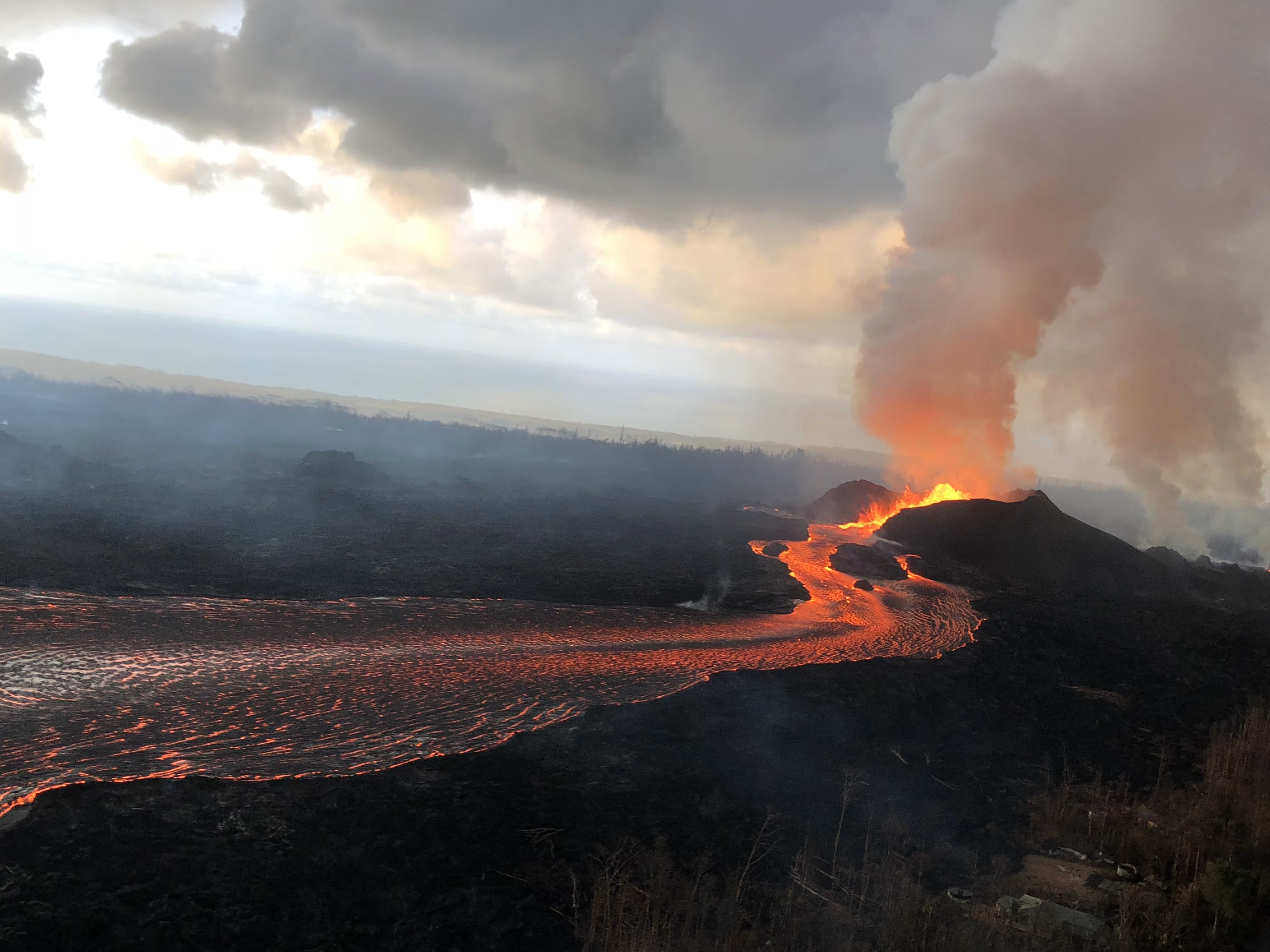
The Discovery: The lava didn't just bring iron; it pushed nutrient-rich deep water to the surface through a process called Thermal Upwelling.
The Result: A massive bloom of Thalassiosira (a type of phytoplankton) appeared within days. This bloom provided enough food to support a sudden surge in the local zooplankton and small fish populations, effectively "feeding" the sea during a time of volcanic crisis.
5.0 The "Laze" Effect: A Hidden Chemical Lab
As lava boils the seawater, it creates a white plume called Laze (Lava Haze). For a chemistry student, this is a fascinating study in acid-base reactions.
- Formation of Hydrochloric Acid (HCl): The heat breaks down the salt (NaCl) in the water, releasing chlorine gas which reacts with steam to form HCl.
- The Mineral Trace: Within this acidic mist are trace elements like Copper (Cu), Zinc (Zn), and Manganese (Mn). While toxic in high concentrations, in the diluted environment of the ocean, these act as vital vitamins for marine microorganisms.
6.0 Deep Sea Hydrothermal Vents: The Permanent Feeders
Not all volcanic feeding happens at the surface. At the bottom of the ocean, Hydrothermal Vents (underwater volcanoes) act as permanent "hot spots" for life.
- Chemosynthesis: In the dark deep sea, there is no sun. Instead, bacteria use the Hydrogen Sulfide (H2S) from the volcanoes to create energy.
- The Ecosystem: This supports giant tube worms, blind shrimp, and "yeti crabs" that exist nowhere else on Earth. The volcano is the only reason these creatures can survive.
7.0 The Global Impact: Carbon Sequestration
Ocean fertilization by volcanoes might actually help fight Climate Change.
- CO2 Absorption: When a volcano triggers a phytoplankton bloom, those billions of tiny plants suck Carbon Dioxide (CO2) out of the atmosphere to grow.
- The Carbon Sink: When the phytoplankton die, they sink to the bottom of the ocean, taking that carbon with them and locking it away for thousands of years.
- Nature's Geoengineering: Some scientists are even looking at "Artificial Ocean Fertilization" (mimicking a volcano) as a way to reduce global warming, though it remains a controversial topic.
9.0 Bibliography (Harvard Style)
Basu, S. (2026). The Geochemistry of Lava-Seawater Interactions. 2nd edn. London: Marine Science Press.
Hawaiian Volcano Observatory. (2024). Lava Entry Hazards: Understanding Laze and Tephra. [online] Available at: https://www.usgs.gov/observatories/hvo [Accessed 4 Feb. 2026].
National Geographic. (2026). When Lava Meets the Sea: The Birth of Ecosystems. [online] Available at: https://www.nationalgeographic.com/environment [Accessed 4 Feb. 2026].
NASA Earth Observatory. (2018). The Kilauea Phytoplankton Bloom: A Satellite Analysis. [online] Available at: https://earthobservatory.nasa.gov [Accessed 4 Feb. 2026].
Thompson, R. and Smith, J. (2025). 'Volcanic Iron Fertilization and its Impact on the Global Carbon Cycle', Journal of Geophysical Research: Oceans, 130(4), pp. 112-128.
Woods Hole Oceanographic Institution. (2026). Life at the Vents: Chemosynthesis Explained. [online] Available at: https://www.whoi.edu/know-your-ocean [Accessed 4 Feb. 2026].
Test Your Knowledge!
Click the button below to generate an AI-powered quiz based on this article.
Did you enjoy this article?
Show your appreciation by giving it a like!
Conversation (0)
Cite This Article
Generating...