Technology
Platform Engineering vs DevOps: The New Engineering Model in 2026
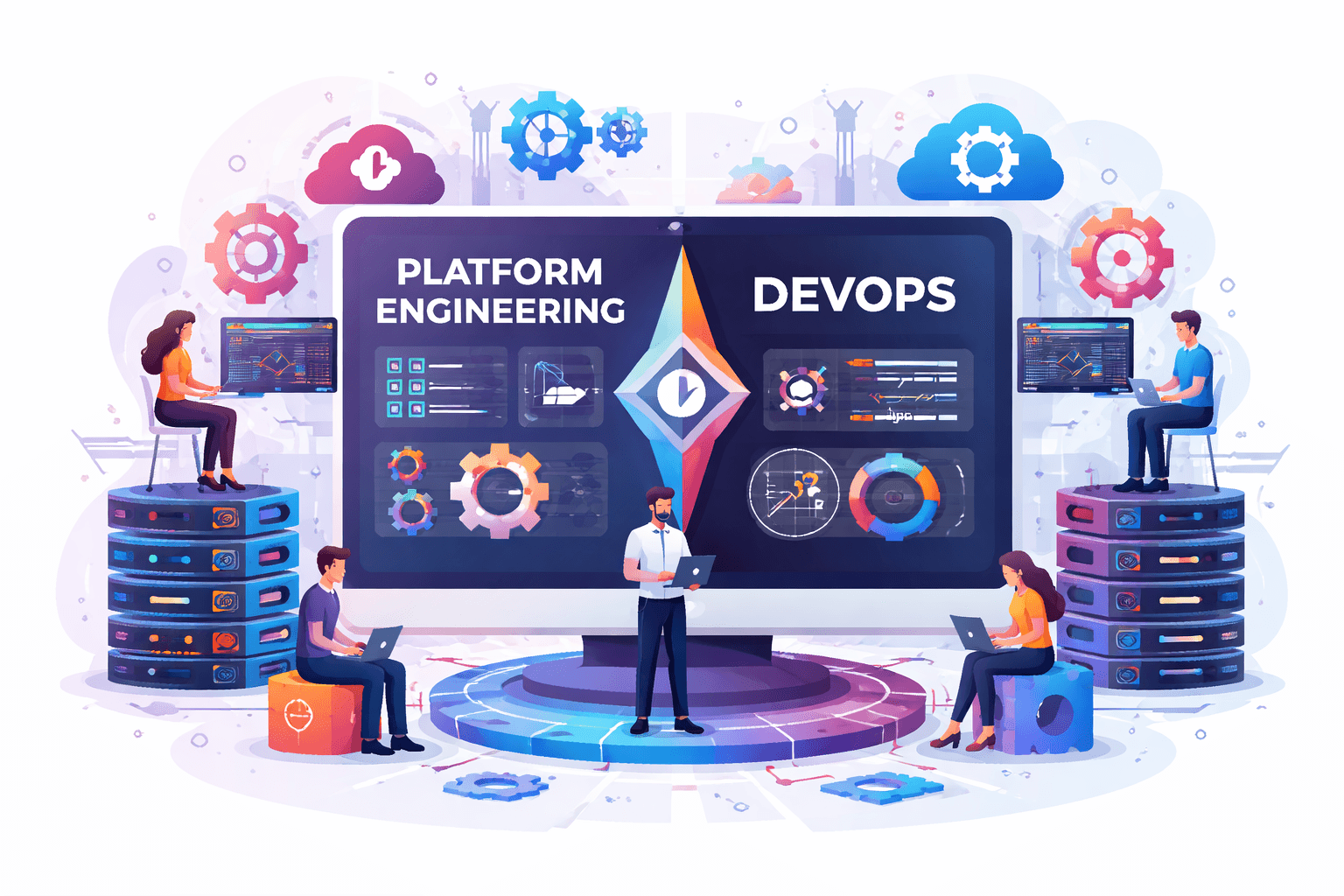
The software industry has continuously been changing with respect to scale, complexity, and speed. DevOps changed the collaboration between development and operations teams ten years ago. DevOps allowed expediting the release cycle, enhancing reliability, and addressing the misalignment of engineering and business objectives by dismantling silos and automating pipelines, which facilitated fast delivery. Nevertheless, nowadays, in 2026, several organizations are realizing that DevOps is no longer fit to handle large-scale, cloud-native systems. With the increase in complexity of distributed architecture and developer productivity as a competitive edge, a new model has developed: Platform Engineering. Platform engineering is not a DevOps replacement and instead an evolution of the same. It brings in organized internal systems, self-service systems as well as standardized engineering systems that are intended to expand contemporary software organizations effectively. The awareness of the distinction between DevOps and platform engineering is vital to teams operating in the current environment of enterprise technology.
The Evolution from DevOps to Platform Engineering
The Devops originated as a culture and functioning change. It was mainly aimed at stopping friction between the operation and development teams. It became a standard practice to adopt continuous integration, continuous delivery (CI/CD), infrastructure as code, and automated testing. Collaboration and automation were some of the key achievements that led to the success of DevOps. However, with the use of microservices, container orchestration, multi-cloud, and distributed systems, the complexity increased in organizations. It required developers to learn more and more about networking, container setup, security policies, Kubernetes manifests and cloud provisioning specifics just to roll out a basic feature. DevOps was supposed to be shared responsibilities, and as it turned out, most teams were lost in the complexity of infrastructure. Infrastructure engineers were accidental developers. They were not concerned with delivering business value but rather troubleshooting YAML files, clusters and configuring pipelines.
What Platform Engineering Actually Means
Platform engineering is the act of creating and maintaining internal developer platforms (IDPs) offering re-usable tools and workflows to software teams on a standard basis. Rather than every team developing its own deployment processes or infrastructure stack, a special platform team develops a curated engineering environment. Platform engineering is concerned with three objectives at its core:
- Lightening the load on developers.
- Best practices standardization.
- Facilitating self-service infrastructure security.
Instead of making all developers an expert in Kubernetes or cloud architecture, the platform team hides the complexity of operations. The interface that developers work with is simplified and the platform is adhering to compliance, reliability and security standards behind the scenes.
Developer Self-Service Infrastructure
Self-service infrastructure is one of the most effective features of platform engineering. Developers are able to provision environments, deploy services as well as configure pipelines on their own instead of filing tickets or waiting on manual approvals. The self-service is not anarchy. It entails automated control. On internal portals or developer dashboards, teams are able to:
- Deploy new microservices on pre-configured templates.
- Provide approved configurations to databases.
- Install applications on standardized CI/CD pipelines.
- Observe performance with inbuilt observability.
This is a strategy that minimizes delays, enhances autonomy, and ensures speedy delivery cycles. Notably, it has a governance that is managed by automated guardrails. The platform itself has security policies and compliance requirements and cost controls integrated into it. Speed and safety are useful to businesses.
Golden Paths and Paved Roads
One of the main ideas of platform engineering refers to the notion of golden paths or paved roads. These are advisory opinionated workflows that direct developers to best practices. The platform team does not provide dozens of combinations of these tools but rather offers curated solutions that are well matching. For example:
- A log and monitoring-preconfigured standard service template.
- A predetermined CI/CD pipeline that will contain a security scan.
- Hardened container images that are approved.
- Combined secret management and access controls.
Golden paths lessen decision fatigue and remove uniform structures across departments. Application developers are free to be innovative on the application layer without concerns on the underlying infrastructure design decisions. This does not do away with flexibility. Where needed teams can branch off however the default route is safe, streamlined and business-friendly.
Internal Developer Platforms (IDPs)
The Internal Developer Platform is in the heart of platform engineering. An IDP serves as the control layer bridging infrastructure, deployment pipelines, monitoring tools, and governance frameworks into a unified experience of the developer. IDPs typically include:
- Service catalogs
- Deployment automation
- Environment Asserting instruments.
- Observability dashboards
- Security and compliance integrations.
Many organizations have been motivated by the popular open source foundations, including Backstage-style portals, to establish centralized developer hubs. These platforms serve as a unified point of entry where engineers are able to control services, consult documentation and communicate with operational tooling. The major distinction between DevOps tooling and an IDP is integration. CI, monitoring and infrastructure are often part of different tools used in DevOps. Platform engineering is an integration of these tools into a lean ecosystem that is targeted to be used internally. The platform is a product and user experience, documentation and support are considered first class.
Why Enterprises Are Investing in Platform Engineering
There are a number of forces that are driving enterprise adoption in 2026.
1. Raising the Complexity of the System: Distributed applications are placed on the cloud providers, edge nodes, and containerized clusters. This complexity would stifle development and the chance of failure is increased without the use of abstraction.
2. Talent Optimization: Infrastructure debugging must not be the task of highly skilled developers but rather business logic and product innovation. Platform engineering secures the productivity of the developer.
3. Security and Compliance: The regulatory demands are increasing. Integrating security and compliance as part of the regular workflows lowers risk and audit.
4. Cost Control: The cost of the cloud may grow exponentially. Platforms would allow setting budgetary restrictions, monitoring usage trends and resource optimization.
5. Organizational Scalability: With a stable engineering background, recruiting new developers is simplified as companies expand. DevOps practices in most enterprises leveled off. Platform engineering is the evolution of operations.
Platform Engineering vs DevOps: A Comparison
DevOps focus on cooperation and self-driving. Platform engineering focuses on abstraction and developer experience. DevOps requires the teams to share the operational responsibility. Platform engineering assembles expertise in a platform team, which develops products in reusable infrastructure. Devops promotes flexibility and experimentation. Platform engineering promotes uniform paths to eliminate risk. Both models coexist. DevOps is still a basic principle, whereas platform engineering outlines and standardizes it.
Challenges of Platform Engineering
Platform engineering has some challenges even with its virtues.
- It requires cultural change.
- It requires platform teams.
- With bad platform designs, they may end up as bottlenecks.
- Excessive standardization can curtail innovation.
Implementation can only be realized by considering the platform as a product that is being developed. Ongoing feedback of developers is needed. It is not control it is enablement.
The Future of Engineering Organizations
Platform engineering is quickly emerging as the new form of large-scale software organization in 2026. With the growth of cloud-native systems and the developer productivity as one of the strategic assets, internal platforms cannot be considered optional anymore. The future of software engineering is in making the cognitive complexity simple and ensuring the operational excellence. When applied together with established platform architecture, enterprises can gain speed and reliability through the application of DevOps concepts. Platform engineering is the evolution of DevOps, and not its substitution. It is an indication of the change in the cultural transformation into the optimization of the system. Those companies that are currently investing in internal developer platforms are setting themselves up to achieve scalable, secure, and sustainable innovation in the future.
Test Your Knowledge!
Click the button below to generate an AI-powered quiz based on this article.
Did you enjoy this article?
Show your appreciation by giving it a like!
Conversation (0)
Cite This Article
Generating...