Engineering
The Airbus A320 Family: The Masterclass of Modular Engineering
1.0 Introduction
In the world of aviation, the Airbus A320 is the "Gold Standard" for short-to-medium haul flights. Launched in the late 1980s, it didn't just compete with the Boeing 737; it revolutionized how planes are flown.
For engineering students and enthusiasts, the A320 is significant because it was the first commercial airliner to introduce Digital Fly-by-Wire (FBW) technology. Before this, pilots were physically connected to the wings via cables and pulleys. In the A320, the pilot moves a "Sidestick" (joystick), sending electronic signals to a computer, which then commands the hydraulic actuators to move the flaps and ailerons.
2.0 The Concept of the "Modular Family"
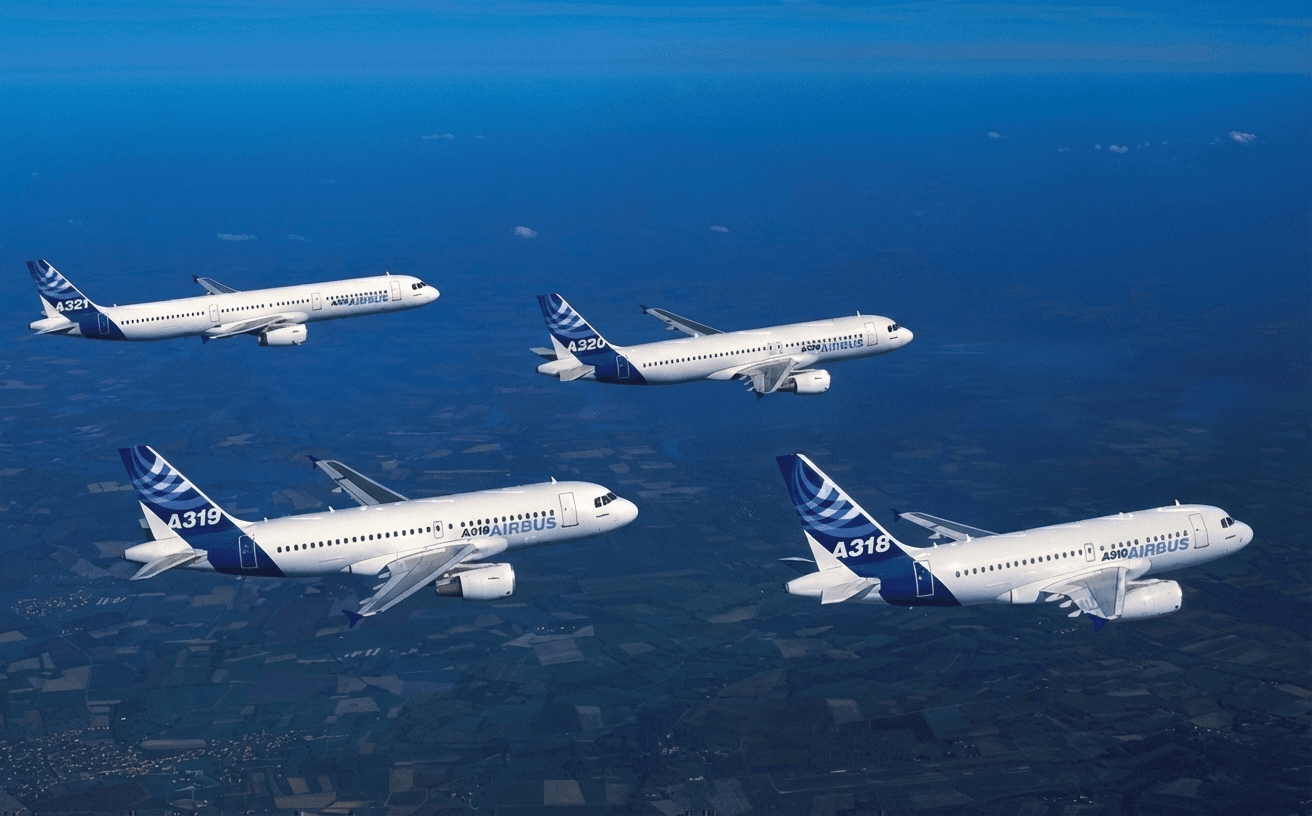
The genius of the A320 project is Commonality. Airbus designed one base aircraft (the A320) and then modified the fuselage length to create different versions.
The Engineering Benefit: All four planes (A318, A319, A320, A321) share the same cockpit layout, the same systems, and the same "Type Rating."
Why it matters: A pilot trained on the tiny A318 can walk into the massive A321 and fly it immediately without extra simulator training. This saves airlines millions in training costs.
3.0 Technical Specifications by Variant
Here is the engineering breakdown of the four family members. Note that these figures are based on the "ceo" (Current Engine Option) and "neo" (New Engine Option) standards, which are the most common in the sky.
3.1 Airbus A318: "The Baby Bus" The smallest member, often used for short hops or landing on very short runways (like London City Airport).
- Engineering Role: Short-haul, Steep Approach capability.
- Fuselage Length: 31.44 meters
- Typical Seat Capacity: 107 (2-class) to 132 (Max)
- Max Take-Off Weight (MTOW): 68 tonnes
- Fuel Capacity: 24,210 Liters
- Range: 5,750 km
3.2 Airbus A319: The "Hot Rod" Slightly longer than the A318. Because it has the powerful engines of the A320 but a lighter body, it has excellent takeoff performance.
- Engineering Role: High-altitude airports, longer thin routes.
- Fuselage Length: 33.84 meters
- Typical Seat Capacity: 124 (2-class) to 156 (Max)
- Max Take-Off Weight (MTOW): 75.5 tonnes
- Fuel Capacity: 24,210 - 30,190 Liters (with ACT - Additional Center Tanks)
- Range: 6,950 km
3.3 Airbus A320: The Standard The baseline model. This is the perfect balance of weight, capacity, and range.
- Engineering Role: The workhorse of domestic aviation.
- Fuselage Length: 37.57 meters
- Typical Seat Capacity: 150 (2-class) to 180 (Max)
- Max Take-Off Weight (MTOW): 78 tonnes
- Fuel Capacity: 24,210 - 30,190 Liters
- Range: 6,100 km (A320ceo) / 6,500 km (A320neo)
3.4 Airbus A321: The "Stretch" The longest version. To prevent the tail from striking the ground during takeoff (Tail Strike), engineers had to redesign the flap system to a double-slotted design for more lift at lower angles.
- Engineering Role: High capacity, Trans-Atlantic routes (A321 XLR).
- Fuselage Length: 44.51 meters
- Typical Seat Capacity: 185 (2-class) to 244 (Max in NX configuration)
- Max Take-Off Weight (MTOW): 93.5 tonnes (Standard) / 97 tonnes (A321 XLR)
- Fuel Capacity: 24,050 - 32,940 Liters (Highly variable due to extra tanks)
- Range: Up to 8,700 km (A321 XLR)
4.0 Engineering Spotlight: Fly-by-Wire Protection
For STEM students, the most fascinating part of the A320 is the Flight Envelope Protection.
Because the plane is controlled by computers, the pilot cannot make the plane crash through aerodynamic error.
Bank Angle Protection: The computer will not allow the plane to roll more than 67 degrees, even if the pilot pushes the stick all the way to the side.
Alpha Floor Protection: If the speed gets too low and the plane is about to stall, the computer automatically applies full engine power (TOGA) and lowers the nose to save the plane.
5.0 Materials and Aerodynamics
Composite Usage: The A320 was the first narrow-body to use significant composite materials (AFRP/CFRP) in the horizontal stabilizer (tail) and spoilers to reduce weight.
Sharklets: Modern A320s feature 2.4-meter tall wingtips called "Sharklets." These reduce the induced drag caused by wingtip vortices, saving about 4% fuel.
6.0 Conclusion
The Airbus A320 family proves that Modularity is the key to profitability in engineering. By creating a flexible platform that shares fuel tanks, cockpits, and wing structures, Airbus allowed airlines to carry 100 people or 240 people using essentially the same machine.
Test Your Knowledge!
Click the button below to generate an AI-powered quiz based on this article.
Did you enjoy this article?
Show your appreciation by giving it a like!
Conversation (0)
Cite This Article
Generating...