Mathematics
The End of the Lonely Genius? Mathematics in the Age of Artificial Intuition
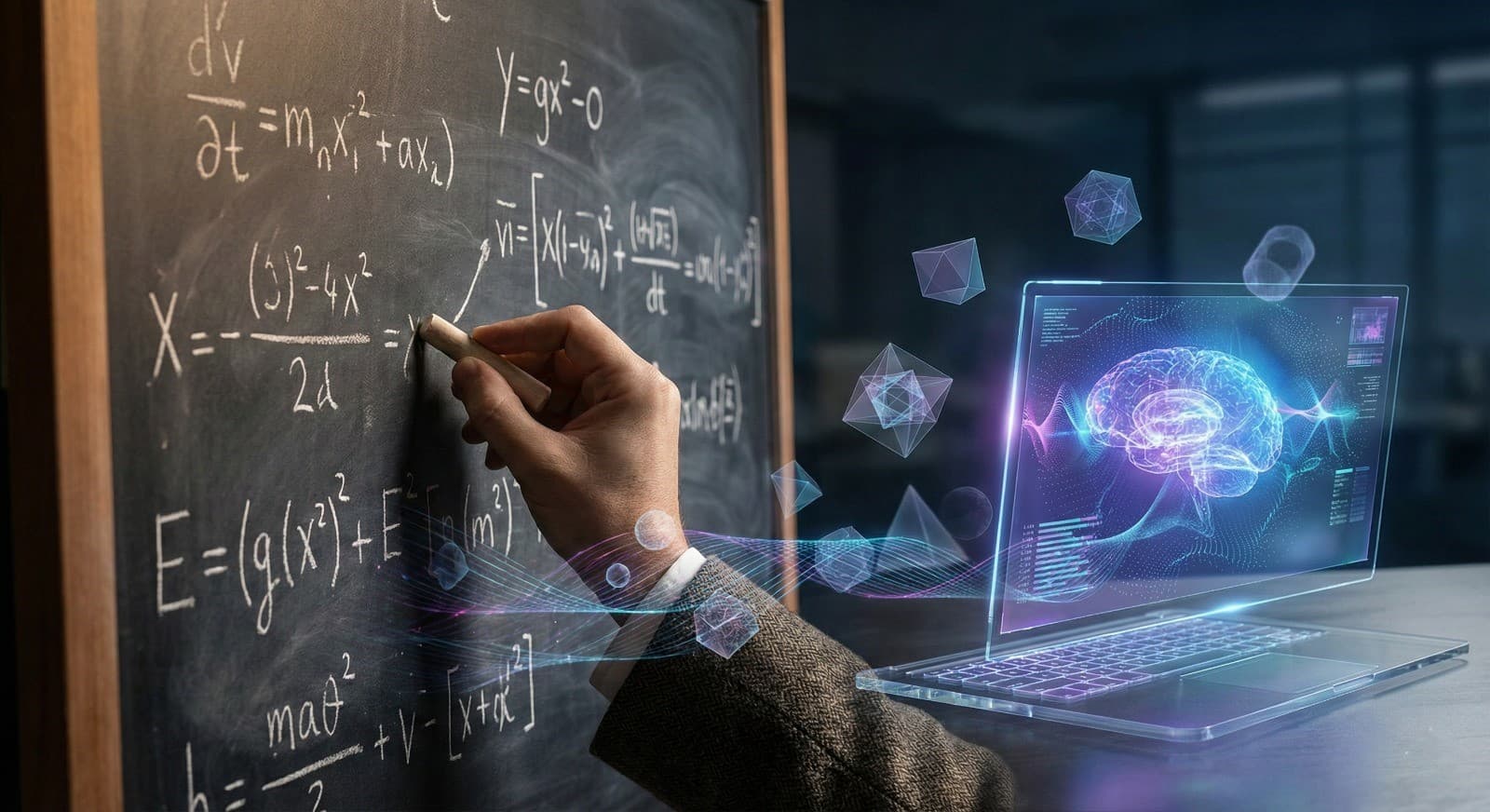
Let’s be honest. For centuries, the image of a mathematician has been somewhat solitary: a genius hunched over a desk, surrounded by crumpled paper, waiting for a lightning strike of insight. Mathematics was a purely human endeavor, bounded by the limits of our biological brains.
That image is now officially outdated.
Welcome to 2026. We are currently living through the most significant shift in mathematical practice since the invention of calculus. The headline isn't just that "AI can do math." We’ve had calculators for decades. The real story, the one that isn't being told enough, is that AI is evolving from a computational tool into a conceptual partner.
It’s no longer about crunching numbers faster; it’s about helping us "see" mathematics differently.
The Death of "Brute Force" and the Rise of "Synthetic Intuition"
Just a few years ago (think back to the early 2020s), the excitement was about AI systems solving International Math Olympiad problems. It was impressive, but it was largely "brute force" massive computing power searching for solutions in ways humans wouldn't.
Today, in 2026, the game has changed completely. The newest generation of AI models aren't just solving problems we give them; they are helping us figure out which problems to ask.
Recent breakthroughs in "neuro-symbolic AI" have given machines something that looks suspiciously like mathematical intuition. By analyzing vast databases of existing mathematical knowledge (far more than any single human could read in a lifetime), these models are beginning to spot hidden patterns and connections between seemingly unrelated fields for example, linking complex number theory to high dimensional geometry.
They are generating novel conjectures (mathematical guesses that might be true). The AI says, "Based on these 10 million examples, it looks like pattern X always leads to result Y." It’s then up to human mathematicians to prove it. The AI provides the spark; the human provides the rigor.
The Translation Revolution: Formalizing the Abstract
Here is perhaps the most profound development happening right now. For centuries, math was written in a mix of symbols and natural language (English, French, German, etc.). This human language is often fuzzy and ambiguous to a computer.
In 2026, we are seeing a massive acceleration in Auto-formalization. AI tools are now incredibly capable of taking complex human mathematical writing and translating it into rigorous computer-checkable code (using languages like Lean or Isabelle).
Why is this huge?
- Instant Verification: It means we can instantly verify if a new, incredibly complex proof is actually correct, eliminating years of human checking.
- A Shared Brain: Once math is turned into this computer code, AI models can "read" and "understand" it deeply. It turns all of human mathematical knowledge into a structured database that AI can learn from, reason about, and build upon.
We are effectively building a universal translator for the language of the universe.
The Human Element: Architects, Not Bricklayers
Does this mean human mathematicians are obsolete? Absolutely not. In fact, their role has never been more critical.
AI is taking over the "heavy lifting" the tedious verification, the endless searching for counter-examples, the brute-force calculation. This frees up human mathematicians to do what they do best: dream.
The role of the mathematician is shifting from being a bricklayer to being an architect. Humans define the direction, ask the deep philosophical questions about the nature of reality, and interpret the strange, beautiful patterns that the AI uncovers. The AI is a high-powered telescope; we still need the astronomer to decide where to point it and understand what they are seeing.
Looking Ahead
We are standing on the edge of a golden age of discovery. Problems that have stumped humanity for centuries like the Riemann Hypothesis or unresolved questions in complexity theory are suddenly looking vulnerable.
The mathematics of the future won't be done by humans alone, and it won't be done by machines alone. It will be a symphony conducted by human creativity, played on instruments of silicon.
Test Your Knowledge!
Click the button below to generate an AI-powered quiz based on this article.
Did you enjoy this article?
Show your appreciation by giving it a like!
Conversation (0)
Cite This Article
Generating...