Technology
The End of Traditional Coding? How AI Is Changing the Way Software Is Built
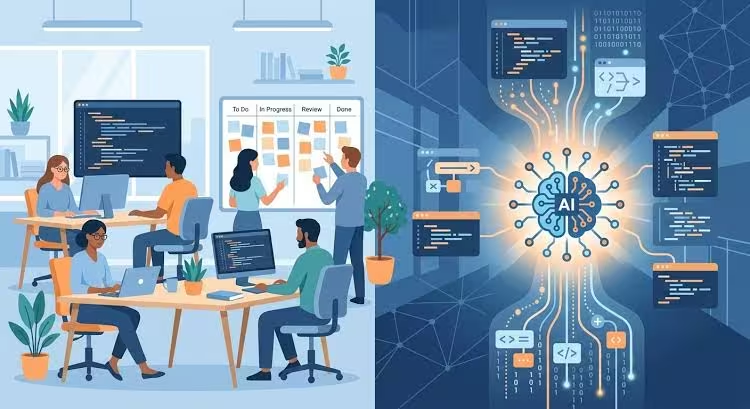
Ask a software developer what their day looked like five years ago, and you would hear about typing, lines of code, one after another, fixing errors and searching forums for answers.
Ask the same question today, and the answer is increasingly different. They describe what they want in plain English, watch an AI assistant write a first draft, then spend most of their time reading, testing, and correcting it.
So, is traditional coding ending? The honest answer is no, but it is changing fast, and what is changing is more interesting than the headlines suggest.
What Has Actually Changed
Using AI to help write software is now normal, not experimental. One 2026 industry survey reported that around 90% of developers regularly use at least one AI tool at work, up from 85% in mid-2025 (JetBrains, cited in Hostinger, 2026). Another, Sonar's 2026 State of Code survey of 1,149 professional developers, found that AI accounts for roughly 42% of the code developers commit, and that developers expect this to reach 65% by 2027 (Sonar, 2026).
Three shifts explain why this feels so different from earlier tools,
1. From autocomplete to agents. Early tools suggested the next line. Today's AI agents can read a codebase, plan a change across many files, run tests, and fix their own errors. On the SWE-bench benchmark, which uses real bug reports from real open-source projects, AI systems went from solving a small fraction of issues to solving around half within a couple of years (Jimenez et al., 2024).
2. From code to conversation. You can now describe software in everyday language. In early 2025, AI researcher Andrej Karpathy popularized the term "vibe coding" for this style, telling the AI what you want, accepting what it produces, and largely not reading the code (Karpathy, 2025). It has opened software creation to people who never learned to program.
3. From writing to reviewing. As AI writes more of the first draft, the developer's job shifts toward directing, checking and deciding. A 2026 survey of developers across 320 organizations found that reviewing had overtaken writing as the single largest AI-assisted time cost (Digital Applied, 2026).
Is It Really Making People Faster?
This is where the story gets more complicated.
Some studies show big gains. In a well-known 2023 experiment, developers using an AI assistant finished a coding task about 56% faster than those without it (Peng et al., 2023). Sonar's survey found that developers reported an average personal productivity boost of 35% (Sonar, 2026).
But other evidence points out the other way. In a 2025 randomized controlled trial, the research group METR studied 16 experienced open-source developers working on 246 real tasks in large, mature codebases they knew well. When allowed to use AI tools, they took 19% longer to finish, even though before the study they had predicted a 24% speed-up, and afterwards they still believed AI had helped (Becker et al., 2025).
It is important not to over-read this. The study was small. It tested early-2025 tools. And it looked at one specific situation, very experienced people in very large, complicated projects. The researchers themselves caution against generalizing. Gains are generally larger on new projects, prototypes and unfamiliar technology, and tools have improved since.
The sensible reading is that AI helps a lot in some situations and little, or even negatively, in others, and people are not always good at judging which situation they are in.
The Trust Problem
The most striking number in Sonar's survey is this, 96% of developers said they do not fully trust that AI-generated code is functionally correct (Sonar, 2026).
That tells us something important. Developers are using AI heavily and double-checking it heavily. Sonar describes a "verification bottleneck", writing code has become fast, but confirming it is correct, secure and maintainable has not.
Researchers studying how professionals work found the same pattern. A 2026 study from UC San Diego and Cornell, combining field observation of 13 developers with a survey of 99 experienced ones, concluded that professionals "don't vibe, they control." They use AI agents but keep close oversight, and they care strongly about software quality (Huang et al., 2026). Similarly, around 72% of developers in one Stack Overflow survey said vibe coding is not part of their professional work (Stack Overflow, cited in Hostinger, 2026).
In other words, the picture of professionals simply typing a wish and shipping the result is mostly a myth. Vibe coding is more popular for personal projects, prototypes and experimentation than for critical systems.
What Is Replaced, and What Is not
Becoming less central,
Typing out routine code, such as standard forms, data handling and boilerplate
Memorizing syntax and searching for how to do common tasks
Writing basic tests and documentation by hand
Becoming more important,
Defining the problem clearly. An AI builds what you describe. If the description is vague, so is the result.
System design. Deciding how the pieces fit together, and what trade-offs to make, still needs human judgement.
Reviewing and verifying. Spotting subtle bugs, security holes and code that works but is hard to maintain.
Security and responsibility. Someone is still accountable when software fails.
Understanding the business and the users. Knowing what is worth building in the first place.
One way to think about it, AI is making the typing cheaper, while making judgement more valuable.
The Risks to Take Seriously
Hidden quality problems. Code that looks right can hide errors. Faster generation without equally strong checks can pile up what engineers call technical debt, shortcuts that become expensive later.
Security. AI can reproduce insecure patterns. Review and automated security scanning remain essential.
The skills gap for beginners. Juniors traditionally learned by writing lots of simple code. If AI does that part, how do they build the deep understanding needed to review it? Companies and educators are still working out the answer.
Over-confidence. The METR result is a reminder that feeling faster and being faster are not always the same thing.
What About Jobs?
Forecasts differ, and nobody knows for certain. Analysts such as Gartner predict that a large share of new enterprise software will be created with vibe-coding techniques by 2028 (Gartner, cited in Hostinger, 2026). But predictions about technology are often wrong in both directions.
What seems likely is that the job changes more than it disappear, less time typing, more time specifying, reviewing and integrating. Demand for people who understand software deeply, especially around security, reliability and architecture, is unlikely to vanish when more software is being produced.
At the same time, people who never considered themselves programmers can now build useful tools. That widens who can create software, which is a real benefit.
What You Can Do
If you are a developer,
Learn to use AI tools well but keep your fundamentals sharp. You cannot review what you do not understand.
Treat AI output as a draft from a fast but fallible colleague.
Invest in testing and verification habits.
If you are learning to code,
Use AI as a tutor, not a crutch. Ask it to explain, then try writing it yourself.
Build projects end to end so you understand how the parts connect.
If you are a manager or business owner,
Pair AI speed with strong review, testing and security checks.
Measure real outcomes, such as quality and delivery time, not just how much code is produced.
If you are not a programmer,
Vibe coding can be great for personal tools and prototypes. For anything handling money, health or private data, involve someone who can review it.
The Bottom Line
Traditional coding is not ending. It is moving up to a level. Less of the work is typing code line by line, and more of it is describing, directing, checking and deciding.
The evidence suggests AI is already part of everyday software work, that its benefits are real but uneven, and that trust, not speed, is now the bottleneck. The winners will not simply be those who generate the most code. They will be those who can verify it fastest and know what it is worth building.
The craft of software is not disappearing. It is changing shape, and the people who understand both the tools and the fundamentals will be best placed to shape what comes next.
Cover image by CatDoes[catdoes.com]
References
Becker, J., Rush, N., Barnes, B. and Rein, D. (2025) 'Measuring the impact of early-2025 AI on experienced open-source developer productivity', arXiv preprint arXiv,2507.09089. Available at, https,//arxiv.org/abs/2507.09089 (Accessed, 25 November 2026).
Digital Applied (2026) AI coding tool adoption 2026, developer survey results. Available at, https,//digitalapplied.com/ai-coding-tool-adoption-2026 (Accessed, 25 November 2026).
Hostinger (2026) Vibe coding statistics, key data, trends, and insights for 2026. Available at, https,//hostinger.com/blog/vibe-coding-statistics (Accessed, 25 November 2026).
Huang, R. et al. (2026) 'Professional software developers don't vibe, they control, AI agent use for coding in 2025', arXiv preprint arXiv,2512.14012. Available at, https,//arxiv.org/abs/2512.14012 (Accessed, 25 November 2026).
Jimenez, C.E., Yang, J., Wettig, A., Yao, S., Pei, K., Press, O. and Narasimhan, K. (2024) 'SWE-bench, can language models resolve real-world GitHub issues?', in Proceedings of the International Conference on Learning Representations (ICLR 2024). Available at, https,//arxiv.org/abs/2310.06770 (Accessed, 25 November 2026).
Karpathy, A. (2025) Post on X (formerly Twitter) introducing the term 'vibe coding', 2 February. Available at, https,//x.com/karpathy (Accessed, 25 November 2026).
Peng, S., Kalliamvakou, E., Cihon, P. and Demirer, M. (2023) 'The impact of AI on developer productivity, evidence from GitHub Copilot', arXiv preprint arXiv,2302.06590. Available at, https,//arxiv.org/abs/2302.06590 (Accessed, 25 November 2026).
Sonar (2026) State of Code developer survey report 2026. Available at, https,//www.sonarsource.com/state-of-code-developer-survey-report (Accessed, 25 November 2026).
Test Your Knowledge!
Click the button below to generate an AI-powered quiz based on this article.
Did you enjoy this article?
Show your appreciation by giving it a like!
Conversation (0)
Cite This Article
Generating...