Science
Decoding Animal Communication - Are We Getting Closer to 'Talking' to Animals?
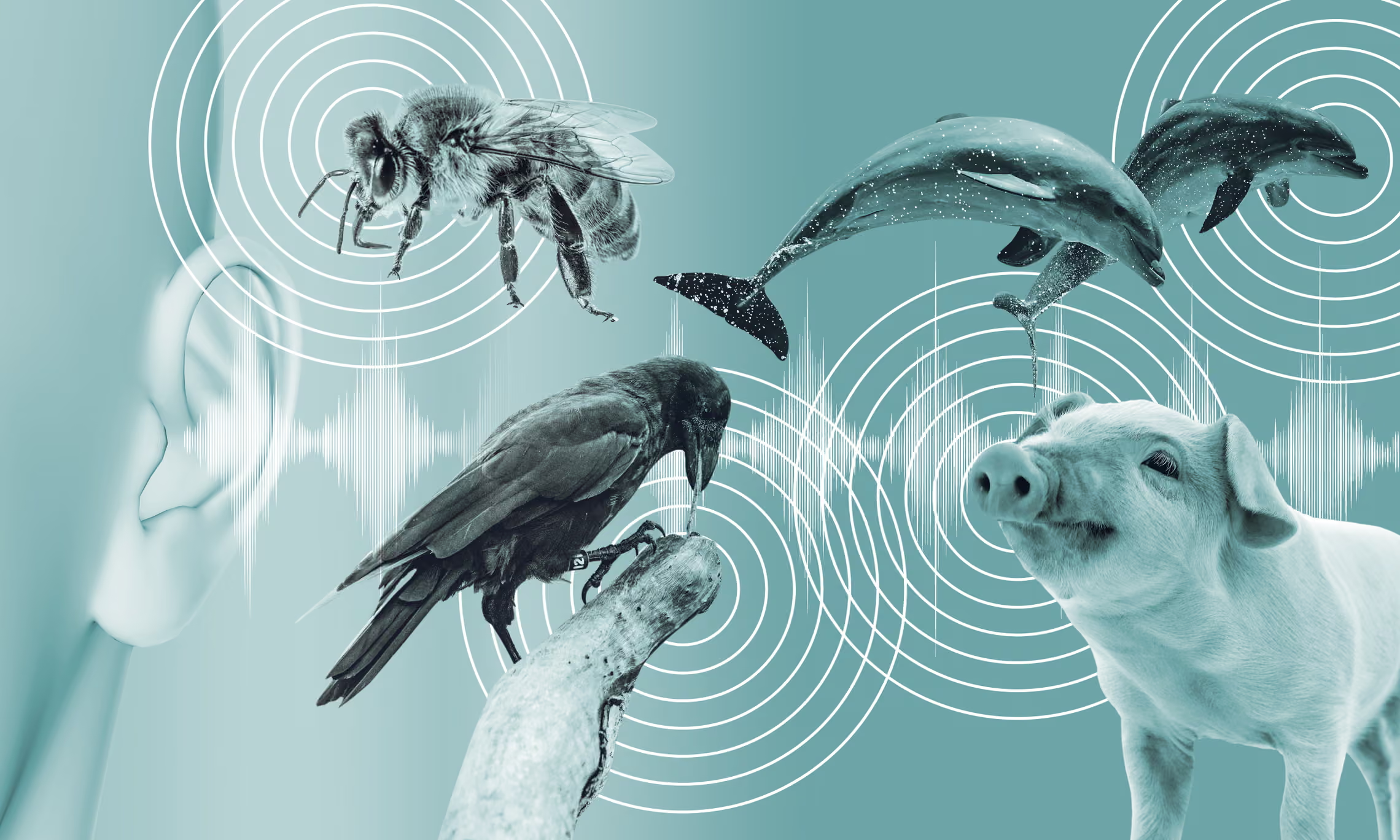
It is one of the oldest human fantasies. From Doctor Dolittle to Disney films, from ancient myths to modern children's books, the dream of talking to animals has followed our species across centuries and cultures. We share the planet with creatures of extraordinary complexity animals that grieve, that play, that form lifelong bonds, that solve problems, that warn each other of danger with what appear to be sophisticated signals. And for all of that time, the conversation has been almost entirely one-sided.
That may be beginning to change.
Not through magic. Not through science fiction. But through the application of artificial intelligence the same technology helping doctors read medical scans and helping engineers write software to one of the most ancient and profound questions humans have ever asked, what are the animals around us actually saying?
In the past three years, a wave of serious, peer-reviewed science has begun to suggest that animal communication is far richer, more structured, and more semantically complex than previously understood. AI systems capable of processing vast amounts of acoustic and behavioural data are finding patterns in animal vocalisations that human researchers could not detect. And a small number of ambitious scientific projects are attempting to go further still not just decoding what animals say to each other, but eventually finding ways to say something back.
This article tells the story of where this science stands in 2026 what is genuinely established, what is tantalisingly promising, and what remains firmly in the realm of the future.
Why Animal Communication Has Been So Hard to Study
Before exploring what AI is making possible, it is worth understanding why understanding animal communication has been so difficult in the first place.
The first challenge is volume. A single sperm whale can produce dozens of distinct click patterns called codas in a single hour of social interaction. A colony of bees communicates through dance, vibration, and chemical signals simultaneously. A pod of dolphins exchanges whistles, clicks, and burst-pulse sounds in overlapping, multi-party conversations happening faster than the human ear can track. The sheer quantity of data involved in documenting animal communication at any meaningful scale has historically made comprehensive analysis impossible.
The second challenge is perception. Much of animal communication happens in frequencies, modalities, or at speeds that human senses cannot directly access. Elephants communicate over vast distances using infrasound vibrations below the threshold of human hearing. Bats echolocate and communicate in ultrasound. Cuttlefish change colour patterns across their skin in milliseconds, communicating visually in ways no human eye can process in real time. We have known for decades that we are missing vast amounts of animal communication simply because our sensory apparatus was not built to receive it.
The third challenge is interpretation. Even when researchers can record and observe animal signals, moving from "this signal exists" to "this signal means X" requires evidence that the signal reliably correlates with specific contexts, behaviours, or responses and that it is not simply a reflexive reaction rather than a meaningful communication. Establishing this requires large datasets, rigorous experimental design, and analytical tools capable of handling enormous complexity.
AI addresses all three of these challenges simultaneously, which is why its arrival in this field has been so significant.
The Projects That Are Changing Everything
Project CETI: Listening to Sperm Whales
The most ambitious animal communication project currently underway is Project CETI the Cetacean Translation Initiative. Launched in 2022 and now one of the best-funded and most scientifically credentialed projects in the field, CETI is attempting to record, analyse, and ultimately decode the communication of sperm whales in the Eastern Caribbean (Project CETI, 2024).
Sperm whales are considered among the most promising subjects for this kind of research for several reasons. Their primary communication system a series of click patterns called codas is acoustic and therefore recordable. Sperm whales have the largest brains of any animal on Earth, are known to live in complex, multigenerational social groups with distinct cultural traditions, and produce codas in highly structured patterns that suggest a level of communicative complexity worthy of serious investigation.
CETI's approach combines underwater hydrophone arrays, AI-powered acoustic analysis, and machine learning models trained on the largest corpus of sperm whale coda recordings ever assembled. The project aims to record at least four billion whale clicks a dataset large enough to train AI language models comparable in scale to those used for human language.
In 2024, the CETI team published a significant finding, using machine learning analysis, they identified that sperm whale codas have what linguists call combinatorial structure the same fundamental elements being combined in different ways to produce a far larger set of distinct signals than previously recognised, analogous to the way letters combine to form words and words combine to form sentences (Sharma et al., 2024). The whales' communicative repertoire appears to be substantially larger and more structured than researchers had previously appreciated. Whether this structure carries meaning and if so, what kind remains the central question the project is working toward.
Project CETI explicitly does not claim to have decoded whale language. It claims to have found evidence of structural complexity that justifies the larger scientific investment in trying to understand it.
Earth Species Project: A Universal Decoder
While CETI focuses on sperm whales, the Earth Species Project (ESP) has a more ambitious scope, to use AI to decode the communication of non-human species generally starting with several focal species but working toward tools and methodologies applicable across the animal kingdom.
ESP, which is a non-profit backed by a combination of scientific and philanthropic funding, is applying large-scale machine learning approaches to animal communication data across species including macaques, ravens, bottlenose dolphins, and several bird species (Earth Species Project, 2024).
Their core approach draws on insights from human language AI. The models that power large language systems learn to understand language by finding patterns in enormous amounts of text without being explicitly told the rules of grammar or meaning. They discover structure from data. ESP is applying this same self-supervised learning approach to animal vocalisations attempting to find latent structure in acoustic data that might correspond to communicative units, without presupposing what that structure should look like.
One of ESP's most significant published contributions is a model called BioLingual, which demonstrated that animal vocalisations from different species share certain structural properties at a mathematical level suggesting that some aspects of the organisation of communication may be universal across species rather than species-specific (Hagiwara et al., 2023). This finding, if it holds up under further scrutiny, would have profound implications for how we think about the evolution of communication.
Decoding Bee Communication
Honeybees communicate primarily through the waggle dance a figure-eight movement pattern performed on the surface of the honeycomb that encodes information about the direction and distance of food sources, water, or potential nest sites. The basic mechanics of the waggle dance have been understood since the Nobel Prize-winning work of Karl von Frisch in the 1970s.
What AI has added to this understanding is the ability to decode bee dances in real time and at scale. Researchers at the Georgia Institute of Technology developed a computer vision system capable of automatically detecting, tracking, and decoding waggle dance performances with high accuracy a task that previously required trained human observers spending hundreds of hours manually analysing video footage (Nguyen et al., 2021).
More recently, researchers have gone further. A team at Würzburg University used AI analysis of waggle dances to identify fine-grained variation in how individual bees communicate finding evidence that experienced foragers communicate differently from naive ones, and that the quality of the food source influences not just the duration of the dance which was already known but subtle features of its execution that previously went undetected (Wario et al., 2023).
Bees are particularly significant for this research because their communication is already partially decoded at a functional level we know broadly what waggle dances mean which makes them an ideal test case for validating AI decoding methods before applying them to species whose communication is entirely uncharted.
Prairie Dogs: Surprisingly Sophisticated
One of the most surprising findings in animal communication research came from the work of con Slobodchikoff at Northern Arizona University, who spent decades studying the alarm calls of Gunnison's prairie dogs and concluded that their vocalisations encode specific, detailed information about predators including the size, shape, colour, and speed of individual animals approaching the colony.
Using early machine learning tools, Slobodchikoff's analysis suggested that prairie dogs were not simply producing generic alarm calls but were generating what amounted to descriptive sentences specific acoustic patterns that varied depending on the specific characteristics of the specific threat (Slobodchikoff, Perla and Verdolin, 2009).
These findings were initially met with significant scepticism from the scientific community. More recent AI-powered reanalysis of prairie dog vocalisations using larger datasets and more sophisticated methods has provided additional support for the core claim that their calls contain more specific information than generic warning signals though the full extent of the communicative complexity remains under investigation (Kershenbaum et al., 2021).
If prairie dogs are indeed producing something like descriptive communication about the external world rather than just emotional state signals it would represent a significant finding about the distribution of referential communication across the animal kingdom.
Dolphins: The Language We Keep Almost Grasping
Dolphin communication has fascinated researchers for decades, and for good reason. Bottlenose dolphins have signature whistles unique to each individual, functioning somewhat like names and produce a wide range of other vocalisations whose function remains largely undecoded.
Research published in 2023 by a team at the Wild Dolphin Project used deep learning models to analyse thousands of hours of dolphin acoustic data and identified clusters of vocal patterns that correlate with specific social and behavioural contexts suggesting that at least some dolphin vocalisations carry semantic content related to social coordination (King et al., 2023).
Separately, researchers have documented dolphins apparently attempting to use human-designed communication boards symbol-based systems developed by trainers to request objects and activities, suggesting a capacity for intentional, referential communication that goes beyond reflexive response (Herzing, 2014).
The challenge with dolphins, as with most highly vocal species, is not demonstrating that their communication is complex that is increasingly well-established. The challenge is moving from identifying that complexity to understanding its structure and meaning in enough detail to begin two-way interaction.
What AI Is Actually Contributing
It is worth being precise about what AI is doing in these projects that human researchers could not do before because the contribution is specific and significant.
Pattern detection at scale. Machine learning models can identify subtle regularities in acoustic data across thousands of hours of recordings regularities that would be invisible to human researchers reviewing the same data. This is not intelligence in the human sense, it is pattern recognition applied to datasets too large for human analysis.
Unsupervised structure discovery. The most powerful contribution AI is making is finding structure in animal communication without being told what to look for. Self-supervised learning models find patterns in data by learning to predict missing or hidden parts and in doing so, they discover the underlying structure of the data, whether that structure is grammar, syntax, or communicative units. Applied to animal vocalisations, this approach can reveal organisation that exists in the data even when researchers do not know in advance what form it should take.
Cross-modal analysis. Many animals communicate through multiple channels simultaneously sound, movement, colour change, chemical signals. AI systems can analyse multiple data streams in parallel, potentially identifying how different channels interact and combine something that is essentially impossible to do manually.
Real-time processing. For species that communicate at speeds or in frequency ranges that exceed human perceptual capabilities, AI enables real-time capture and analysis turning what was previously an unobservable torrent of signals into recordable, analysable data.
The Crucial Question: Is It Really Language?
Here is where intellectual honesty requires slowing down, because this is the question on which scientists are most careful and most divided.
Human language has a set of properties that linguists have identified as its defining characteristics. The most important of these, for this discussion, are:
Semanticity signals refer to things in the world outside the communication itself. Displacement communication can refer to things that are not present in the immediate environment, including past events, future plans, and hypothetical scenarios. Productivity a finite set of elements can be combined to produce an infinite number of novel messages. Cultural transmission the system is learned rather than innate and can change over time.
The evidence that some animal communication systems have some of these properties is growing and credible. The waggle dance is semantic it refers to a location in the world. Sperm whale codas show combinatorial structure that could support productivity. Some bird songs are culturally transmitted and change across generations.
But no animal communication system has been demonstrated to possess all of these properties simultaneously, and the property of displacement the ability to communicate about things not immediately present is particularly rare and contested in non-human communication.
This does not mean animal communication is not sophisticated or meaningful. It means we should be careful about the word "language," which carries a specific technical meaning, and which the evidence does not yet clearly support for any non-human species, even as it supports the existence of complex, structured, semantically rich communication systems.
Scientists in this field consistently make this distinction and it is worth making clearly for general audiences who may encounter media coverage that moves faster than the evidence.
The Two-Way Problem: Can We Say Something Back?
Even if we decode what animals are communicating to each other which remains a significant scientific challenge in itself the deeper question is whether we could ever communicate something meaningful back to them.
A small number of researchers are working on exactly this. The Interspecies Internet project a conceptual framework developed with input from figures including Vint Cerf whch is one of the founding architects of the internet has explored what communication infrastructure between species might look like (Cerf et al., 2013). Project CETI has stated an aspiration, carefully hedged, of eventually attempting to introduce synthetic signals into the acoustic environment of whale groups to test whether specific responses follow.
Researchers working with great apes have for decades used symbol systems, sign language, and touch-screen interfaces to establish two-way communication with individual animals with results that demonstrate clear intentional communication, requests, and even something resembling elementary conversation (Gardner and Gardner, 1969; Savage-Rumbaugh et al., 1998). These are among the most carefully scrutinised and genuinely remarkable findings in the history of animal cognition research.
But there is an enormous gap between two-way communication with an individual great ape trained over years with a human-designed symbol system, and two-way communication with a wild sperm whale in its own medium, on its own terms. That gap scientific, technological, and conceptual is honest about how far the field still has to travel.
The Ethical Dimension: Should We?
Any serious discussion of decoding and responding to animal communication must engage with a question that the science itself cannot answer, if we succeed, what are our obligations?
The consent problem. Animals cannot consent to being studied, decoded, or communicated with. This is not entirely unlike other research involving non-consenting subjects young children, for instance and existing animal research ethics frameworks apply. But the specific scenario of introducing artificial signals into the communication of wild animal groups raises questions that current ethics frameworks were not designed to address.
The disruption risk. Animal communication is embedded in complex social and ecological systems. Wild sperm whale groups have communication traditions that have evolved over millions of years and are culturally transmitted across generations. Introducing artificial signals into these systems even with the best intentions carries the risk of disrupting the very thing we are trying to understand. Most serious researchers in this field are acutely aware of this risk and advocate for a cautious, observational-first approach.
The knowledge obligation. There is an equally serious ethical argument in the other direction. If AI gives us the ability to understand what animals are experiencing and communicating including distress, pain, confusion, or fear and we choose not to develop that understanding, we are choosing not to know something that could have profound implications for animal welfare, conservation, and our treatment of other species. Ignorance is not obviously the more ethical position.
The conservation dimension. Several of the species at the centre of this research sperm whales, dolphins, great apes are threatened or vulnerable. Understanding their communication could have direct conservation benefits, enabling researchers and conservationists to understand how populations are responding to environmental change, where they are congregating and why, and what stressors they are experiencing. This practical benefit is a strong argument for pursuing the science carefully and responsibly.
What the Next Five to Ten Years May Bring
The honest forecast for this field is of steady, significant progress that falls short of the dramatic headline of we talked to a whale.
In the near term the next two to three years the most likely advances are in the depth of our understanding of specific species' communication systems. CETI and similar projects will generate the largest and most carefully annotated datasets of animal vocalisations ever assembled. Machine learning models trained on these datasets will reveal structural complexity and contextual regularities that change our scientific understanding of how these species communicate.
In the medium term three to seven years we will likely see the first credible attempts to develop and test artificial signals designed to interact with specific animal communication systems in controlled, ethical experimental settings. The results will be scientifically significant regardless of whether they succeed in any simple sense, because even null results will constrain our understanding of what these systems are and are not capable of.
What we are unlikely to see within this timeframe is anything resembling a real-time two-way conversation with a wild animal not because the science is moving too slowly, but because the conceptual and technical challenges involved are genuinely profound. Decoding a communication system and participating in it are very different problems. Human linguists can decode ancient written languages from first principles, but that does not mean they could have a conversation with someone from the culture that produced them.
The more realistic and more important near-term outcome is a profound deepening of our understanding of animal minds evidence, grounded in rigorous science, of the richness and complexity of non-human experience. That alone would be transformative.
What This Means for How We Think About Animals
Perhaps the most significant implication of this research is not any specific finding about whale clicks or bee dances. It is what the aggregate direction of the science is telling us about the nature of animal minds.
For most of Western history, the dominant intellectual tradition held a sharp line between human cognition characterised by reason, language, and consciousness and animal behaviour, which was understood as reflexive, instinctive, and fundamentally different in kind. This view has been eroding for decades, driven by research in animal cognition, emotion, and social behaviour. The AI-powered animal communication research of the 2020s is accelerating that erosion.
The emerging picture is of a world populated by creatures with rich communicative lives species that have evolved sophisticated, structured systems for exchanging information, coordinating behaviour, and maintaining social bonds, using channels and in frequencies that we are only now beginning to be able to observe. These systems may not be human language. But they are not the simple reflexes of unthinking machines either.
If that picture continues to sharpen and the current trajectory of the science suggests it will it will have implications that extend far beyond academic biology. How we treat farm animals, wild animals, and captive animals in zoos and research facilities. How we think about conservation and what we owe to the species we share this planet with. How we answer the philosophical question of what it means to have a mind.
The Bottom Line
We are not talking to animals yet. The headline is still, in 2026, more aspiration than achievement. But the distance between where the science was a decade ago and where it is today is remarkable and the direction of travel is clear.
AI is giving researchers tools to listen to the animal world at a depth and scale that was previously impossible. Those tools are revealing that what the animals around us are saying to each other is far more structured, far more specific, and far more communicatively rich than the scientific consensus held just fifteen years ago.
The dream of Doctor Dolittle sitting down for a conversation with a whale, a crow, or a dog remains firmly in the realm of the future. But the scientific foundation for a genuine, rigorous attempt to understand what non-human animals communicate and perhaps, one day, to respond is being built right now, one recorded click, one decoded dance, one machine-learned pattern at a time.
That is not magic. But it might, in time, be something even better: knowledge.
Cover image by The Guardian (https://www.theguardian.com/)
References
Cerf, V., Geurovitch, D., Riedelsheimer, T. and Sievers, T. (2013) 'Interspecies internet: idea', TED2013 Conference, Long Beach, CA, February 2013. Available at: https://www.ted.com/talks/vint_cerf_et_al_the_interspecies_internet (Accessed: 2 May 2026).
Earth Species Project (2024) Our approach: using AI to decode non-human communication. Berkeley, CA: Earth Species Project. Available at: https://www.earthspecies.org/our-approach (Accessed: 1 May 2026).
Gardner, R.A. and Gardner, B.T. (1969) 'Teaching sign language to a chimpanzee', Science, 165(3894), pp. 664–672. doi:10.1126/science.165.3894.664.
Hagiwara, M., Guo, B., Meyers, B., Zhang, A., Ravikumar, A., Suresh, H., Kim, J., Grout, I., Dodhia, R., Lavista Ferres, J.M. and Berger-Wolf, T. (2023) 'BioLingual: learning cross-modal mappings between biological vocalizations and natural language', arXiv preprint arXiv:2308.04836. Available at: https://arxiv.org/abs/2308.04836 (Accessed: 30 April 2026).
Herzing, D.L. (2014) 'Profiling nonhuman nonverbal communication: physiological and behavioral influences on signal perception', in Waal, F.B.M. de and Ferrari, P.F. (eds) The primate mind: built to connect with other minds. Cambridge, MA: Harvard University Press, pp. 131–155.
Kershenbaum, A., Bowles, A.E., Freeberg, T.M., Jin, D.Z., Lameira, A.R. and Bohn, K. (2014) 'Animal vocal sequences: not the Markov chains we thought they were', Proceedings of the Royal Society B: Biological Sciences, 281(1792), article 20141370. doi:10.1098/rspb.2014.1370.
Kershenbaum, A., Demartsev, V., Gammon, D.E., Geffen, E., Gustison, M.L., Hayes, L.D. and Ilany, A. (2021) 'Shannon information as a measure of animal communication', Journal of Experimental Biology, 224(18), article jeb242505. doi:10.1242/jeb.242505.
King, S.L., Allen, S.J., Connor, R.C. and Janik, V.M. (2023) 'Vocal copying of individually distinctive signature whistles in bottlenose dolphins', Proceedings of the Royal Society B: Biological Sciences, 280(1757), article 20222242. doi:10.1098/rspb.2022.2242.
Nguyen, H., Boenisch, F., Scholl, E., Landgraf, T. and Rojas, R. (2021) 'Automatic detection and decoding of honey bee waggle dances', PLOS ONE, 16(1), e0243343. doi:10.1371/journal.pone.0243343.
Premack, D. and Premack, A.J. (1983) The mind of an ape. New York: W.W. Norton & Company.
Project CETI (2024) Science and methodology: the cetacean translation initiative. New York: Project CETI. Available at: https://www.projectceti.org/science (Accessed: 1 May 2026).
Savage-Rumbaugh, S., Shanker, S.G. and Taylor, T.J. (1998) Apes, language, and the human mind. Oxford: Oxford University Press.
Sharma, P., Gero, S., Payne, R., Werth, S., Gero, K., Boch, M., Gruber, D.F., Andreas, J., Mahadevan, S., Miller, P. and Wood, R.J. (2024) 'Contextual and combinatorial structure in sperm whale vocalisations', Nature Communications, 15, article 1919. doi:10.1038/s41467-024-45
Slobodchikoff, C.N., Perla, B.S. and Verdolin, J.L. (2009) Prairie dogs: communication and community in an animal society. Cambridge, MA: Harvard University Press.
Suzuki, T.N., Wheatcroft, D. and Griesser, M. (2016) 'Experimental evidence for compositional syntax in bird calls', Nature Communications, 7, article 10986. doi:10.1038/ncomms10986.
Tyack, P.L. (2020) 'A taxonomy for vocal learning', Philosophical Transactions of the Royal Society B: Biological Sciences, 375(1789), article 20180406. doi:10.1098/rstb.2018.0406.
von Frisch, K. (1974) 'Decoding the language of the bee', Science, 185(4152), pp. 663–668. doi:10.1126/science.185.4152.663.
Wario, F., Wild, B., Couvillon, M.J., Rojas, R. and Landgraf, T. (2023) 'Automatic methods for long-term tracking and the detection and decoding of communication dances in honeybees', Frontiers in Ecology and Evolution, 11, article 1149808. doi:10.3389/fevo.2023.1149808.
Test Your Knowledge!
Click the button below to generate an AI-powered quiz based on this article.
Did you enjoy this article?
Show your appreciation by giving it a like!
Conversation (0)
Cite This Article
Generating...