Technology
When Computers Learn to See - Everyday Applications of Computer Vision
Computers used to be blind, they could process numbers and text, but images were just pixels with no meaning. Computer vision changes that. It gives machines the ability to interpret photos and videos in ways that are useful for people: recognizing faces, spotting defects, reading signs, and much more. Thanks to advances in deep learning, especially convolutional neural networks (CNNs), computer vision has moved from research labs into everyday products that many people use without realizing it.
One of the most familiar applications is smartphones and social media. When your phone unlocks by scanning your face, computer vision is at work comparing the live image to a stored pattern. Photo apps can automatically group pictures by person, location, or even activity, such as beach or birthday, by detecting faces, objects, and scenes. Social media platforms use similar techniques to suggest tags, enhance images, and filter out inappropriate or harmful content. These systems must be fast and accurate, operating on millions of images every day.
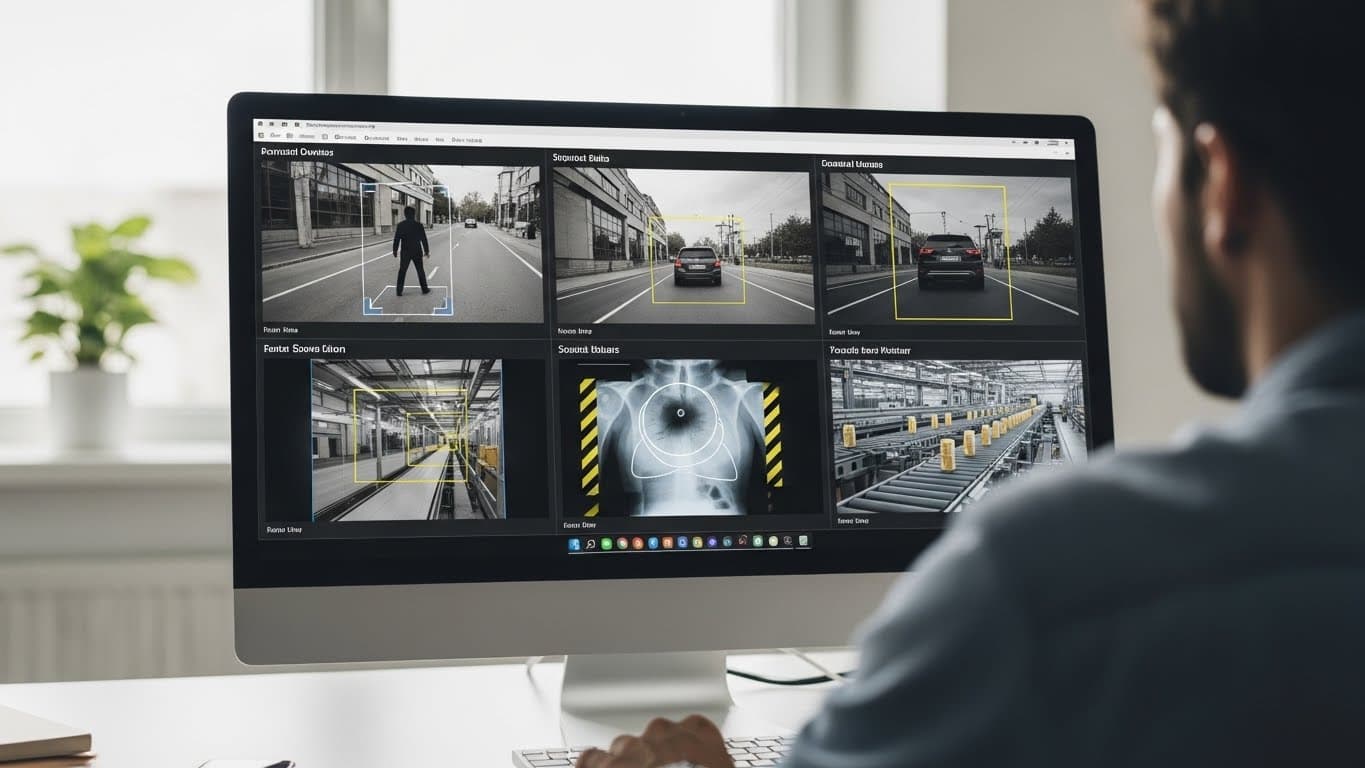
Computer vision is also transforming healthcare. Medical imaging tools like X rays, CT scans, and MRIs produce enormous amounts of visual data. Vision models can help doctors by highlighting suspicious areas such as tiny tumors, fractures, or blocked blood vessels that may be difficult to spot with the naked eye. They do not replace medical professionals but serve as a second pair of eyes, improving early detection and reducing human fatigue. In some cases, vision systems are also used to track how diseases progress over time or to measure the effects of treatment by comparing images taken at different stages.
In transport and mobility, computer vision plays a crucial role in driver assistance systems and autonomous vehicles. Cameras mounted on cars constantly scan the surroundings to recognize lanes, traffic signs, pedestrians, cyclists, and other vehicles. The system then uses this information to keep the car in its lane, maintain safe distances, apply emergency brakes, or even drive itself in certain conditions. Similar ideas are used in traffic management, where cameras monitor intersections to optimize signal timing and reduce congestion, or in parking systems that guide drivers to free spaces.
Industry and manufacturing rely heavily on automated inspection using computer vision. On production lines, high speed cameras capture images of products as they move past. Vision algorithms check for defects such as scratches, missing components, or incorrect labels much faster and more consistently than human inspectors. This kind of quality control is used in electronics, food packaging, pharmaceuticals, and many other sectors. In warehouses and logistics, vision helps robots identify packages, read barcodes, and navigate safely among shelves and workers.
Another growing area is security and safety. Surveillance cameras enhanced with computer vision can detect unusual events, such as a person entering a restricted area, objects left unattended, or sudden crowd movements. In workplaces like construction sites or factories, vision systems can check whether workers are wearing helmets and safety vests. While these applications can improve safety, they also raise important questions about privacy and responsible use, since constant monitoring can feel intrusive if not handled with clear rules and transparency.
Computer vision also enables creative and educational tools. Apps can translate text from signs in real time using the phone camera, allowing travelers to understand foreign languages instantly. Others can identify plants, animals, or landmarks, turning a simple photo into a learning moment. In sports, vision tracks players and the ball to generate analytics and visual replays. In retail, “smart mirrors” let customers virtually try on clothes or makeup by overlaying products onto their reflection. Artists and designers use vision powered tools to blend real and digital elements, creating interactive installations and augmented reality experiences.
Despite these successes, computer vision is not perfect. Models can still be confused by unusual lighting, angles, or objects they have never seen before. If they are trained on biased datasets, they may perform worse on certain groups of people or environments, which is especially serious in security and healthcare contexts. That is why careful data collection, testing, and ethical guidelines are essential whenever vision systems are deployed in real life.
Overall, computer vision has quietly become one of the most influential branches of AI. By teaching machines to see, it connects the digital world with the physical one, enabling applications that range from fun smartphone features to life saving medical tools. As technology improves, we can expect even more helpful, interactive, and immersive experiences if accuracy, fairness, and privacy are kept at the center of how these systems are designed and used.
Test Your Knowledge!
Click the button below to generate an AI-powered quiz based on this article.
Did you enjoy this article?
Show your appreciation by giving it a like!
Conversation (0)
Cite This Article
Generating...