Science
Placental Abruption - The Pregnancy Emergency Every Parent Should Know About
What Is Placental Abruption?
The placenta is the organ that grows in the womb during pregnancy. It attaches to the wall of the uterus and passes oxygen and nutrients from the mother to the baby through the umbilical cord.
In a placental abruption, the placenta separates from the wall of the uterus, partly or completely, before the baby is born. The separated area can no longer deliver oxygen and nutrients, and bleeding occurs behind the placenta.
Abruption happens roughly 1 in 100 to 1 in 200 pregnancies (Tikkanen, 2011). Severity varies widely. A small separation may cause few problems, while a large one can cut off the baby's oxygen supply and cause severe bleeding in the mother.
The Warning Signs
The symptoms can vary, and not everyone has all of them.
Vaginal bleeding. This is the best-known sign, but not always present. In a significant minority of cases the blood stays trapped behind the placenta, so there may be little or no visible bleeding even when the abruption is serious (Tikkanen, 2011).
Abdominal or back pain, often sudden and continuous rather than coming and going like normal labor pains.
A tender or hard uterus. The belly may feel firm or rigid to the touch.
Frequent or constant contractions, sometimes coming very close together.
Reduced movement from the baby.
Signs of heavy blood loss, such as dizziness, faintness, a racing heartbeat or pale, clammy skin.
If you are pregnant and have bleeding, severe abdominal pain, a rigid belly or a sudden change in your baby's movements, seek emergency care immediately. Call your local emergency number or go to the nearest maternity unit or emergency department. Do not wait to see if it settles, and do not delay because there is "not much blood."
Who Is at Higher Risk?
Abruption can happen to anyone, including women with no risk factors at all. But some things raise the chances (Ananth and Kinzler, 2023; RCOG, 2011):
A previous placental abruption. The risk of it happening again is substantially higher, roughly 10 to 15% by some estimates.
High blood pressure, including chronic hypertension and pre-eclampsia.
Smoking during pregnancy.
Cocaine or other stimulant drug use.
Abdominal trauma, such as a car accident, a fall or physical violence.
Waters breaking early, or infection in the womb.
Twins or multiple pregnancy.
Older maternal age.
Certain blood clotting conditions and some other medical problems.
Having a risk factor does not mean abruption will happen, and many cases occur without one.
How Is It Diagnosed?
Doctors mainly diagnose placental abruption from the symptoms and examination, along with monitoring of the baby's heartbeat.
Ultrasound can be surprisingly unreliable. It often fails to show an abruption even when one is present, because fresh blood can look like the placenta on a scan (Glantz and Purnell, 2002). A normal scan does not rule it out. Blood tests may be done to check blood loss and clotting, and to arrange blood for transfusion if needed.
What Happens in Treatment?
Treatment depends on how severe the abruption is, how many weeks pregnant the mother is, and how both mother and baby are doing.
Mild cases with a stable mother, a baby that is coping well and an early stage of pregnancy may be monitored closely in hospital. Steroid injections may be given to help the baby's lungs mature if early birth is possible.
Severe cases are emergencies. The care team will:
Stabilize the mother with IV fluids and, if needed, blood transfusion.
Monitor the baby's heartbeat continuously.
Plan the safest way and time to deliver. When the baby is distressed or the mother is bleeding heavily, this is often an emergency caesarean section.
If the mother is stable, a vaginal birth may sometimes be possible (RCOG, 2011).
Risks for Mother and Baby
For the mother, serious abruption can cause heavy bleeding, blood clotting problems, the need for transfusion, and in rare cases kidney problems or a hysterectomy.
For the baby, the risks include early birth, poor growth, low oxygen levels, lasting health problems and, in the most severe cases, stillbirth. Research from the United States found the risk of perinatal death was many times higher in pregnancies with abruption than without it (Ananth and Wilcox, 2001). The risk depends heavily on severity and on how quickly care is given, which is why fast action matters.
Many babies survive and do well, particularly when the abruption is recognized early and the birth is managed promptly.
Can It Be Prevented?
Not entirely, because many causes are not within anyone's control. But some steps lower risk (Ananth and Kinzler, 2023):
Go to all antenatal appointments, so blood pressure problems and pre-eclampsia are caught early.
Don't smoke, and avoid alcohol and recreational drugs. Ask for support to stop if needed.
Take any blood pressure medication as prescribed.
Wear a seatbelt correctly when pregnant, with the lap strap under the belly and across the hips.
Seek help if you face violence at home. Pregnancy is a time when abuse can become more dangerous.
If you've had an abruption before, tell your care team early so they can plan monitoring and delivery.
The Emotional Side
Placental abruption is often sudden and frightening. Parents may go through emergency surgery, a premature baby in intensive care, or the loss of a baby. It is common to feel shock, grief, anger or guilt.
Placental abruption is rarely caused by anything the mother did or didn't do. The cause is often unknown, and it is not your fault. If you have been through it, ask your midwife, doctor or a local support organization about counselling and peer support. Talking to someone is a normal part of recovery, not a sign of weakness.
The Bottom Line
Placental abruption is uncommon, but it is a true pregnancy emergency. Remember three things:
Know the signs: bleeding, pain, a hard belly, frequent contractions, reduced baby movement.
Act quickly: go to hospital straight away, even if bleeding is light or absent.
Plan: attend antenatal care, manage blood pressure, avoid smoking and drugs, and tell your team about any previous abruption.
Speed makes the biggest difference, and knowing what to look for is the first step.
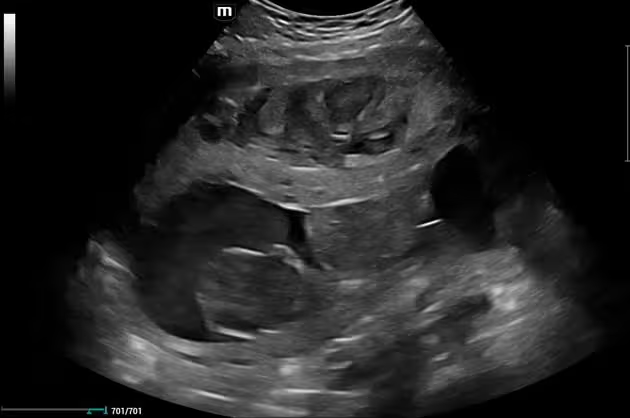
Cover Image by Radiopaedia [radiopaedia.org]
References
Ananth, C.V. and Kinzler, W.L. (2023) 'Placental abruption: clinical features and diagnosis', UpToDate. Available at: https://www.uptodate.com (Accessed: 17 November 2026).
Ananth, C.V. and Wilcox, A.J. (2001) 'Placental abruption and perinatal mortality in the United States', American Journal of Epidemiology, 153(4), pp. 332–337. doi:10.1093/aje/153.4.332.
Glantz, C. and Purnell, L. (2002) 'Clinical utility of sonography in the diagnosis and treatment of placental abruption', Journal of Ultrasound in Medicine, 21(8), pp. 837–840. doi:10.7863/jum.2002.21.8.837.
Royal College of Obstetricians and Gynaecologists (RCOG) (2011) Antepartum haemorrhage: Green-top Guideline No. 63. London: RCOG. Available at: https://www.rcog.org.uk (Accessed: 17 November 2026).
Tikkanen, M. (2011) 'Placental abruption: epidemiology, risk factors and consequences', Acta Obstetricia et Gynecologica Scandinavica, 90(2), pp. 140–149. doi:10.1111/j.1600-0412.2010.01030.x.
Test Your Knowledge!
Click the button below to generate an AI-powered quiz based on this article.
Did you enjoy this article?
Show your appreciation by giving it a like!
Conversation (0)
Cite This Article
Generating...