Technology
Sense, Think, Act
Understanding Sensors, Actuators, and Signal Processing
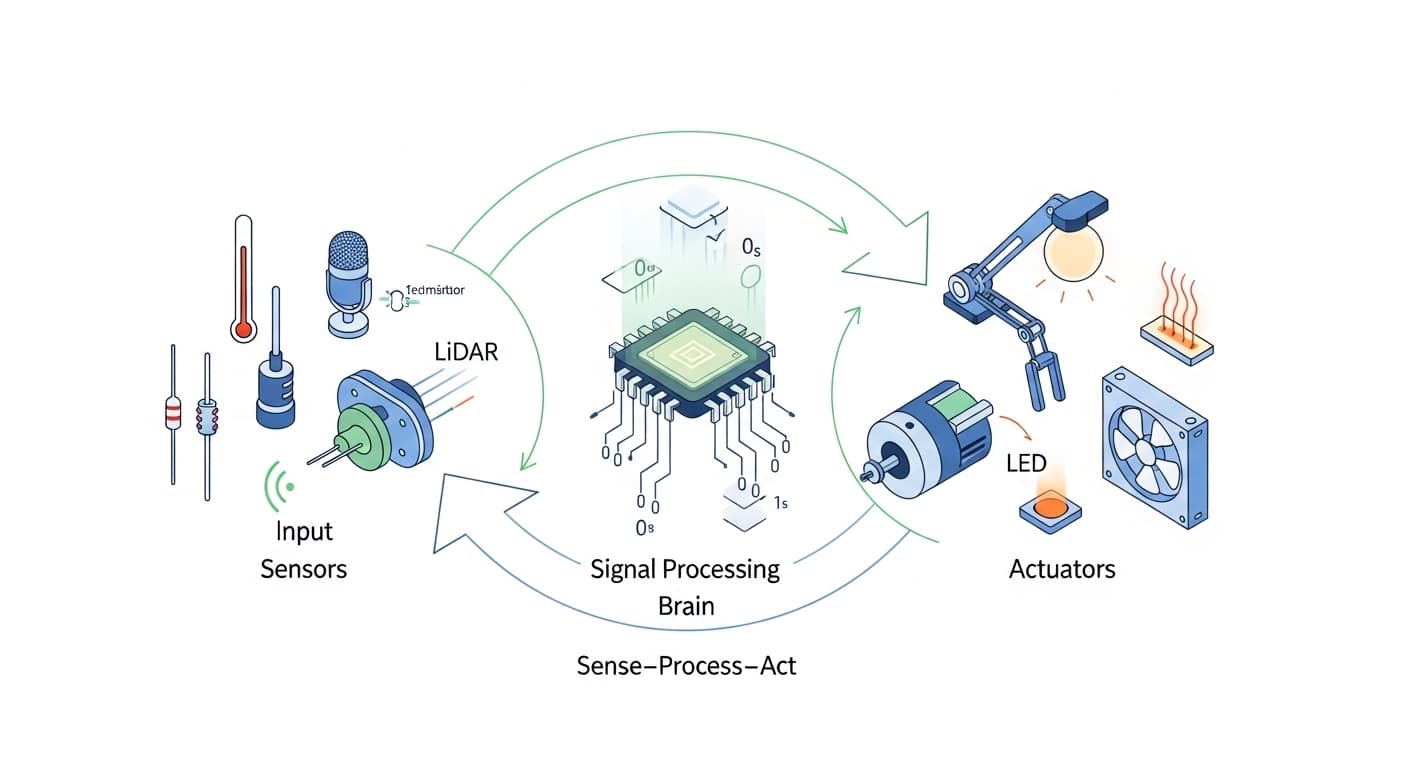
Due to its association with computers and the computer industry, software engineering seems to exist solely on a screen-code in, text out. However, under Robotics and the Internet of Things (IoT) the world, code must be able to touch the physical world. The system is based on a constant loop with three essential parts, Sensors (Input), Signal Processing (The Brain), and Actuators (Output), whether it is an autonomous vehicle braking when a person steps in a crossroad or an intelligent thermostat with an air conditioner.
We need to deconstruct the anatomy of a smart machine.
1. Sensors - The Senses (Input)
A Sensor is a gadget that identifies variations of the surrounding and transforms them into an electric signal. The eyes and ears of the machine are them.
- What they do? They quantify physical properties- light, heat, motion, pressure or sound.
- The Problem - The real world is analog (continuous/smooth) whereas computers are discrete (binary/digital). The temperature sensor is not transmitting the value of 25C to the CPU, it is transmitting a small, varying voltage.
Examples
- Thermistor - Resistance varies with heat (thermostat).
- Accelerator - Senses movement and gravity (enabled to change your phone screen).
- Lidar - It involves the use of lasers to map distance (autonomous cars).
2. Signal Processing - The Translation Layer.
When you directly connect a raw sensor to a computer, it will not be understood by the computer. The signal may be too small, too noisy or in an incorrect format. Herein Signal Processing comes in.
The three steps included in this stage are,
- Conditioning - Cleaning up the signal. In the event of electrical noise (static), filters are used. In case the signal is too weak, amplifiers are used to enhance the signal.
- Conversion (ADC) - It is the magic moment. The continuous voltage is fed to an Analog-to-Digital Converter (ADC) which converts it to a stream of 1s and 0s that can be read by the processor.
- Output - The data is analyzed by the CPU (microcontroller).
Example - "The sensor reads 28°C. My logic says the limit is 24°C. Action required."
3. Actuators - The Muscles (Output).
After making the decision to act, the computer must be able to influence the real world. An Actuator is a device which transforms an electrical signal of control into physical energy (motion, light, or heat).
- What they perform? They perform the command of the processor and cause something to happen.
- The Conversion (DAC) - Sometimes, a Digital-to-Analog converter converts the digital command back into an analog voltage so as to change the speed or intensity of the action in a smooth manner.
Examples
- Electric Motor - Rotates wheels or robotic arms.
- Servo - this is a motor that is precise in the adjustment of the flaps on an airplane wing.
- LED/Display - A lighting source that is used to provide visual feedback to a human.
The Feedback Loop - Coming together.
Feedback Loop is the real force behind these systems. Suppose there were an automated Air Conditioner,
- Sensor - Senses the air in the room (Input).
- Processing - Temp is too high (Decision) Read by CPU.
- Actuator - Switches on the compressor (Action).
- Loop - The sensor continues to measure. When the temperature level falls below the value, the CPU sends the actuator to a halt.
Our machines would be sightless and out of control without this loop. This flow Sense, Process, Act is the key to the modern automation.
Test Your Knowledge!
Click the button below to generate an AI-powered quiz based on this article.
Did you enjoy this article?
Show your appreciation by giving it a like!
Conversation (0)
Cite This Article
Generating...