Science
The Genetic Secret in Your Ears: Why Dry Earwax Means You Lack Body Odor
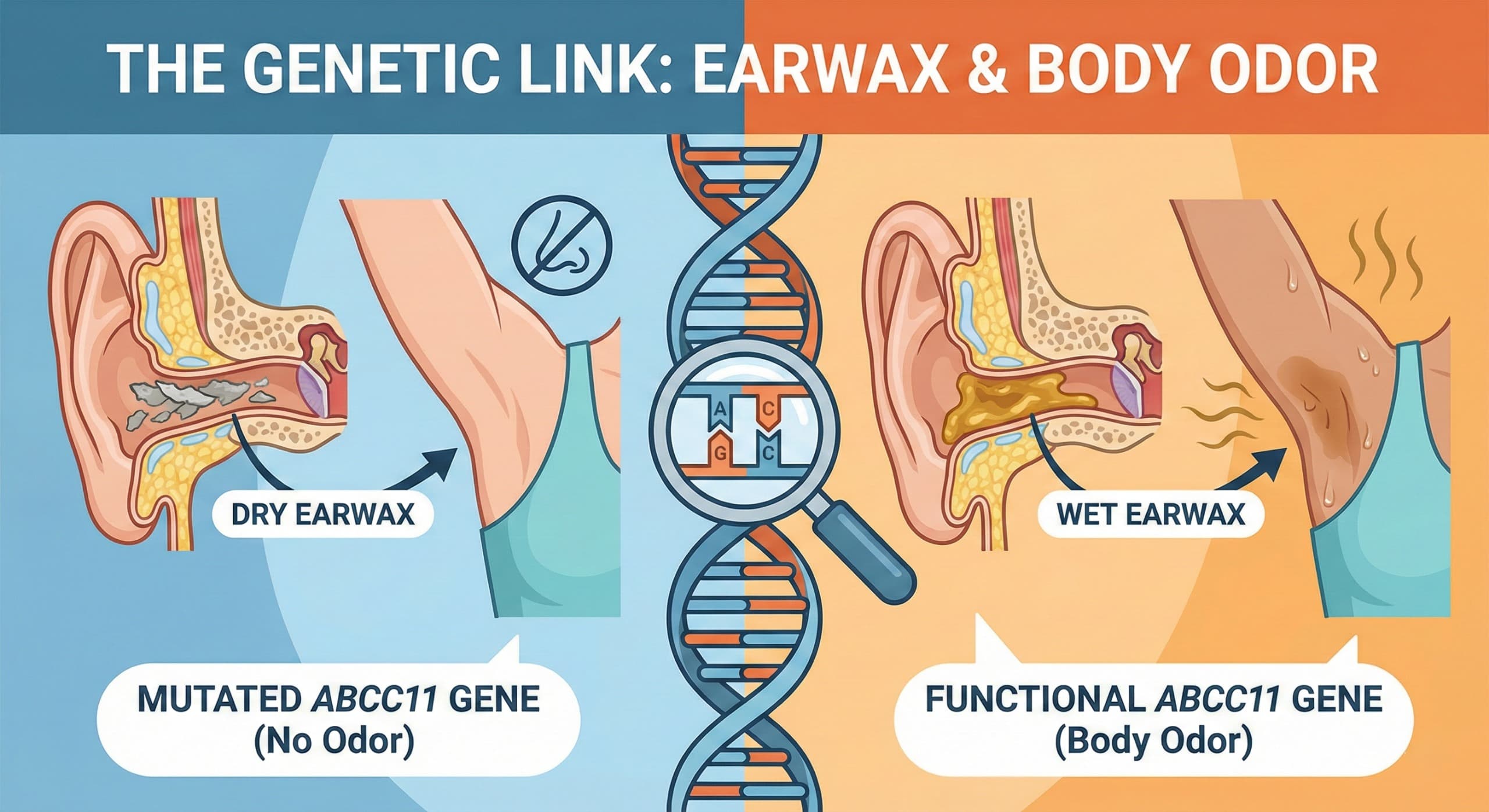
1.0 Introduction: The Myth That Is Actually Science
If someone told you that looking inside your ear could tell you whether you need to wear deodorant, you would probably assume it was an old wives' tale or an internet myth. It seems absurd to connect earwax consistency with armpit odor.
Yet, this is one of those rare instances where the "myth" is 100% biologically accurate.
For students of biology and genetics, this connection is a perfect case study of pleiotropy where a single gene influences two seemingly unrelated physical traits. The culprit is a tiny piece of DNA known as the ABCC11 gene, and it acts as the body’s microscopic gatekeeper for both earwax and body odor.
2.0 The Mechanism of Sweat and Smell
To understand the connection, we first need to debunk a common misconception: sweat itself does not have a smell.
The human body has two primary types of sweat glands:
- Eccrine Glands: Found all over the body, these release mostly salt water to cool you down. This sweat is odorless.
- Apocrine Glands: Concentrated in the armpits and groin, these glands become active during puberty. They secrete a thicker, milky fluid rich in lipids (fats) and proteins.
The Role of Bacteria: Your skin is covered in bacteria, particularly Corynebacteria. These bacteria love the lipids found in apocrine sweat. They feast on these fats, and the waste products they excrete are what we recognize as the characteristic smell of body odor.
No lipids = No food for bacteria = No smell.
3.0 The "Pump" Gene: ABCC11
This is where genetics comes into play. How do those fats get into the sweat in the first place?
The ABCC11 gene provides the instructions for your body to build a specific protein transporter think of it as a microscopic "pump" located in the cells of your apocrine glands.
- The Functional Gene (Wet/Smelly): In most populations (European and African descent), the ABCC11 gene works normally. The pump efficiently moves lipids out of the cells and into the sweat. The bacteria are fed, and body odor is produced.
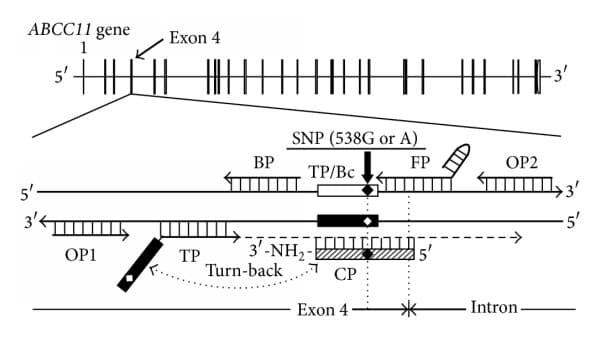
- The Mutated Gene (Dry/Odorless): A tiny mutation a single nucleotide change in the DNA (specifically, a switch from Guanine to Adenine at position 538) breaks this pump. It can no longer transport lipids effectively. The apocrine sweat remains watery and fat-free. The bacteria starve, and the person produces virtually no body odor.
4.0 The Earwax Connection: The Visible Clue
So, why does looking in your ear reveal the state of your armpits?
Evolution is efficient; it rarely reinvents the wheel. The glands in your ear canal that produce cerumen (earwax) are simply modified apocrine sweat glands.
They rely on the exact same ABCC11 pump to push lipids and moisture into the ear canal to create the sticky, golden-brown substance we know as "wet" earwax.
If you carry the mutated ABCC11 gene, the pump is broken in both your armpits and your ears. Without that influx of fats and moisture, the earwax produced is gray, brittle, and flaky "dry" earwax.
Therefore, your earwax type is a visible genetic marker for the functional state of your ABCC11 pump.
5.0 A Global Genetic Map
This mutation is a fascinating example of human genetic diversity. The "dry/odorless" mutation is surprisingly common in certain parts of the world.
Genetic studies have shown that over 90% of people in East Asia (specifically Korea, Japan, and Northern China) carry the mutated version of the gene, meaning the vast majority have dry earwax and lack body odor.
Conversely, in populations of European or African descent, the mutation is rare (less than 2%), meaning wet earwax and the presence of body odor are the standard phenotype.
6.0 Conclusion: The Power of a Single Letter
It is sobering to realize that the difference between needing daily deodorant and never needing it at all comes down to a single "letter" change in our 3 billion base-pair DNA code.
The ABCC11 gene is a powerful reminder that in genetics, nothing is truly isolated. A single molecular mechanism can manifest in ways that seem totally unconnected on the surface linking the wax in our ears to the microbiome in our armpits.
7.0 Bibliography (Harvard Style)
Martin, A. et al. (2010). A functional ABCC11 allele is essential in the biochemical formation of human earwax. The FASEB Journal, [online] 24(3). Available at: https://faseb.onlinelibrary.wiley.com/doi/full/10.1096/fj.09-146662 [Accessed 21 Feb. 2026].
National Institutes of Health (NIH). (2024). ABCC11 gene: ATP binding cassette subfamily C member 11. [online] MedlinePlus Genetics. Available at: https://medlineplus.gov/genetics/gene/abcc11/ [Accessed 21 Feb. 2026].
Rudden, M. et al. (2020). The molecular basis of thioalcohol production in human body odour. Scientific Reports, 10(1), p.12500.
Yoshiura, K. et al. (2006). A SNP in the ABCC11 gene is the determinant of human earwax type. Nature Genetics, [online] 38(3), pp.324–330. Available at: https://www.nature.com/articles/ng1733 [Accessed 21 Feb. 2026].
Test Your Knowledge!
Click the button below to generate an AI-powered quiz based on this article.
Did you enjoy this article?
Show your appreciation by giving it a like!
Conversation (0)
Cite This Article
Generating...