Mathematics
The Hidden Math in Your Pocket - How Mathematics Powers Your Mobile Life
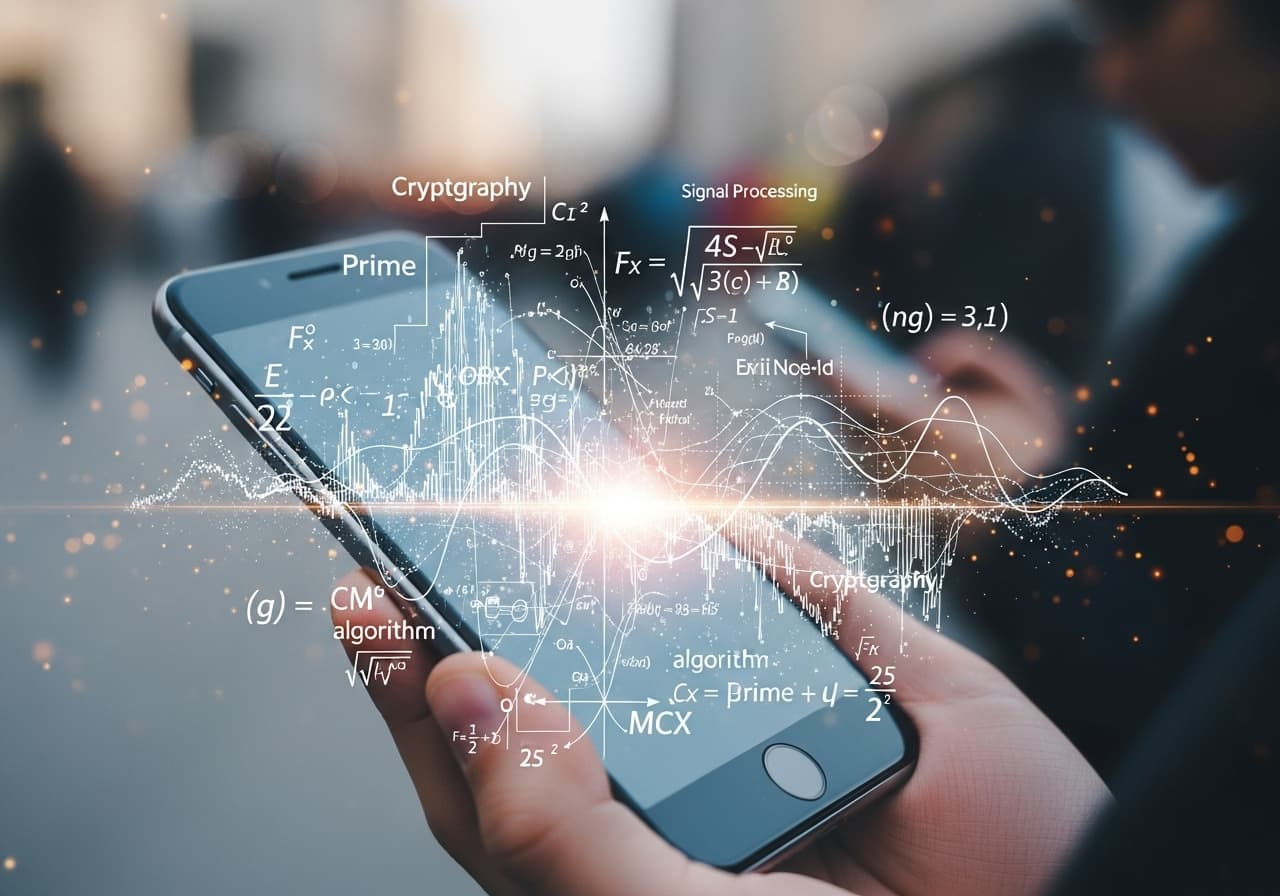
When you unlock your smartphone, you aren't just engaging with a marvel of engineering; you are stepping into a world governed by elegant, complex, and invisible mathematics. We often think of math as a classroom subject involving chalkboards and calculators, but in the modern era, math is the "ghost in the machine" that makes your digital life possible.
From the way you navigate city streets to the filters you use on your selfies, here is how mathematics runs your favorite mobile applications.
- The Geometry of Navigation (GPS)
Every time you open Google Maps or Uber, you are using Trigonometry and Geometry on a global scale.
Your phone communicates with satellites orbiting the Earth. To find your exact location, the app uses a process called trilateration. By calculating the distance between you and at least four satellites using the formula d=vt (distance equals velocity times time), the app solves a system of sphere equations to pinpoint your latitude, longitude, and altitude.
- The Linear Algebra of Instagram Filters
Ever wonder how a "Vintage" filter instantly changes the mood of a photo? Your digital images are essentially massive matrices—grids of numbers representing pixel colors (Red, Green, and Blue).
When you apply a filter, the app performs Matrix Multiplication. It applies a mathematical transformation to every single pixel coordinate and color value simultaneously. Advanced image recognition (like identifying your face for a "dog ears" filter) relies on Convolutional Neural Networks, which use calculus and linear algebra to detect edges, shapes, and textures.
- The Number Theory of Secure Messaging
When you send a "private" message on WhatsApp or Signal, math ensures that no one—not even the app developer—can read it. This is powered by Cryptography.
Most secure apps use RSA Encryption or Elliptic Curve Cryptography (ECC). These methods rely on the "Prime Factorization Problem." It is mathematically easy to multiply two enormous prime numbers together, but it is computationally "impossible" for even the fastest supercomputers to reverse the process and find the original factors without a digital key. Your privacy is literally protected by the difficulty of high-level arithmetic.
- The Graph Theory of Social Media
Facebook, LinkedIn, and X (formerly Twitter) see the world as a Graph. In mathematical terms, a graph consists of nodes (users) and edges (the connections between them).
Social media algorithms use Graph Theory to suggest "People You May Know." The app analyzes the path length between you and a stranger. If there are many short paths (mutual friends), the algorithm calculates a high probability that you should be connected.
- The Calculus of Battery Life
Even the hardware management of your phone is math-heavy. To ensure your battery doesn't die by noon, mobile operating systems use Calculus to manage power consumption.
By calculating the derivative of your energy usage over time, the system can predict when the battery will run out and adjust the CPU clock speed or screen brightness accordingly. This optimization ensures that the "area under the curve" (total energy capacity) lasts as long as possible.
The Verdict
The next time you scroll through a feed, tap a "Buy Now" button, or hail a ride, remember that beneath the sleek UI and colorful icons, there are billions of equations being solved every second. Mathematics isn't just a school subject—it’s the language of the modern world, sitting right there in the palm of your hand.
What part of mobile math surprised you the most? Let us know in the comments!
Test Your Knowledge!
Click the button below to generate an AI-powered quiz based on this article.
Did you enjoy this article?
Show your appreciation by giving it a like!
Conversation (0)
Cite This Article
Generating...