Science
The "Sleep-Tooth" Connection

1. The "Panic Button" Theory
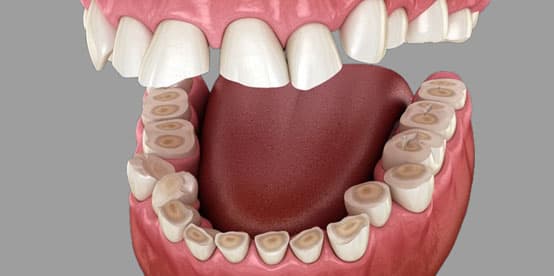
Most people think teeth grinding (the technical term is Bruxism) is just a nervous habit. But in many cases, your jaw is actually acting as a "manual override" for your breathing.
When you fall into a deep sleep, your muscles relax. For many people, the tongue and soft tissues in the throat relax so much that they partially block the airway. When your brain realizes you aren't getting enough oxygen, it panics. It sends a signal to your jaw muscles to clench and grind.
The Goal: This movement pulls your lower jaw forward, which moves your tongue out of the way and reopens your airway so you can breathe again.
2. The "Scalloped Tongue" & Other Secret Clues
Your teeth are the "black box" of your sleep history. A 2026 dentist doesn't just look for cavities; they look for these "red flags":
- Flat Peaks: If the sharp "hills" of your back teeth look like they’ve been sanded down, you’ve been grinding.
- The Scalloped Tongue: Look in the mirror. If the edges of your tongue have "waves" or indentations that match your teeth, it means your tongue is too big for your mouth or is being pushed against your teeth because your airway is crowded.
- Bony Bumps (Tori): Small, hard lumps of bone under your tongue or on the roof of your mouth. These often grow as a response to the massive pressure of night-time clenching.
3. Why "Over-the-Counter" Guards Can Be Dangerous
This is the most important part people don't know. If you buy a "boil-and-bite" mouthguard from a pharmacy to stop the grinding, you might actually be making your health worse.
If your grinding is a response to blocked breathing (Sleep Apnea), a thick, soft mouthguard can take up even more space in your mouth. This pushes your jaw back further, making it even harder to breathe. You might stop the noise of the grinding, but you’ll be suffocating more often throughout the night.
4. The 2026 Solution: AI & 3D Orthotics
In 2026, we don't just "block" the grinding; we solve the breathing.
- AI Sleep Screening: Dentists now use wearable rings or bedside AI monitors that track your oxygen levels while you sleep.
- MADs (Mandibular Advancement Devices): These are custom-made, 3D-printed devices that look like clear retainers. They are designed to gently hold your lower jaw slightly forward while you sleep, keeping the airway open so your brain never has to hit the "grind" panic button.
5. The Results: More Than Just a Smile
When you fix the Sleep-Tooth connection, the benefits go way beyond your mouth:
- No more morning headaches: Usually caused by jaw muscles working "overtime" all night.
- Endless Energy: Because you are finally reaching deep, REM sleep without being interrupted by "breathing panics."
- Lower Blood Pressure: Chronic sleep-breathing issues put massive strain on your heart.
Test Your Knowledge!
Click the button below to generate an AI-powered quiz based on this article.
Did you enjoy this article?
Show your appreciation by giving it a like!
Conversation (0)
Cite This Article
Generating...