Mathematics
Why We Think Math is Hard - The Psychology Behind the Numbers
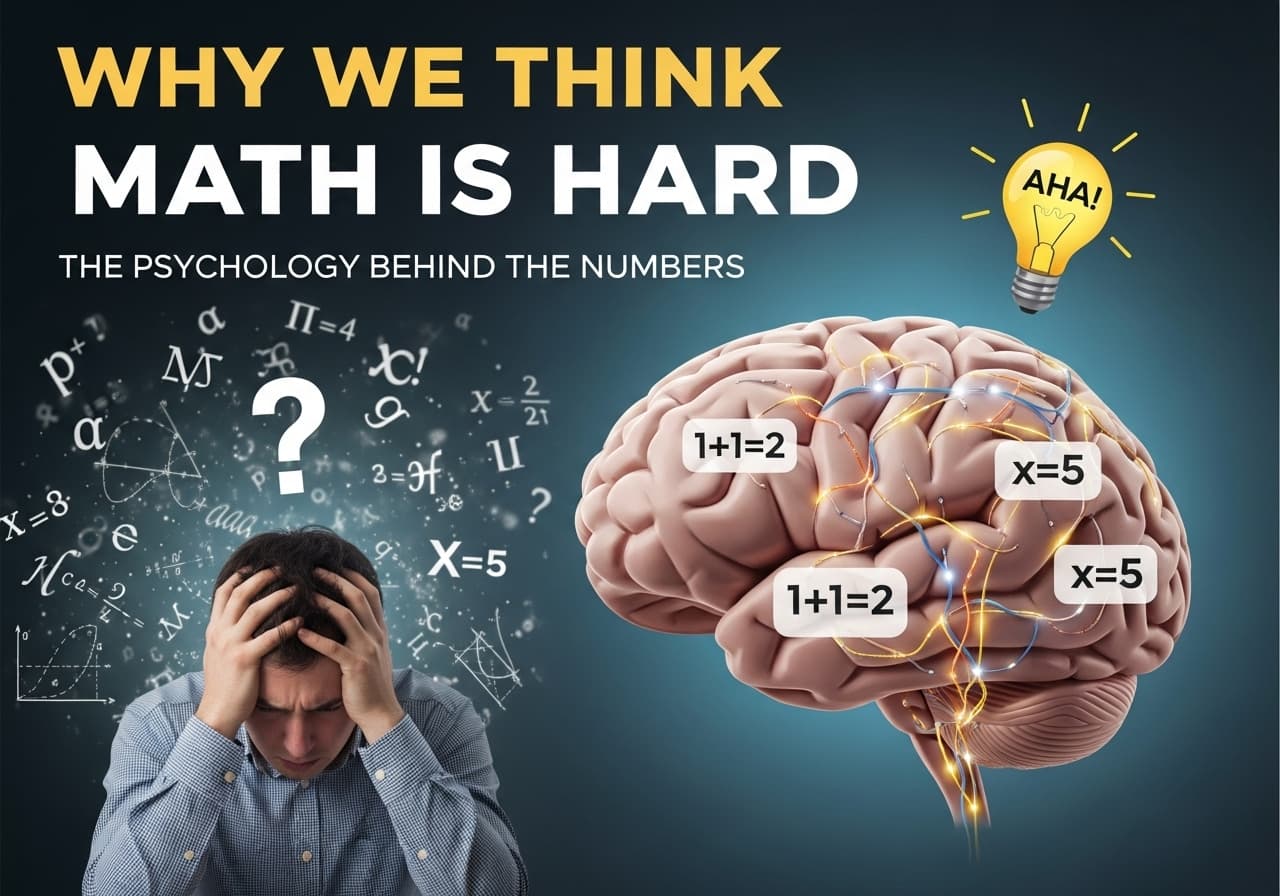
In our previous look at the "hidden math" in your smartphone, we saw that formulas like d = vt are the quiet architects of our digital world. On the surface, math is a language of absolute logic and simplicity. So, why does the mere mention of a "math problem" send a shiver down the spine of so many people?
The disconnect between how math is and how we perceive it is one of the most fascinating hurdles in modern education.
- The "Cumulative Architecture" Problem
Unlike many other subjects, math is strictly hierarchical. If you don't understand how to calculate distance using d = vt , you will struggle with the calculus of motion later.
In a history class, you can understand the French Revolution even if you missed a lecture on the Roman Empire. In math, a single "missing brick" in your foundation can make the entire structure feel unstable years down the line. Most people don't find math hard; they are simply struggling with a gap in their foundational knowledge that hasn't been addressed.
- The Myth of the "Math Brain"
One of the biggest psychological barriers is the cultural myth that you are either "born with it" or you aren't. We often view math as an innate talent rather than a skill to be practiced.
This creates a Fixed Mindset. When a student hits a difficult concept, they don't think, "I need to practice this more." Instead, they think, "I’m just not a math person." This belief leads to "Math Anxiety," which actually clogs the working memory, making it physically harder to solve problems.
- Abstraction vs. Reality
In your mobile apps, math is active and invisible. However, in the classroom, math is often taught as a series of abstract manipulations.
When we see d = vt on a whiteboard, it looks like a chore. When we see it as the reason we can find our way to a new restaurant in a strange city, it becomes a tool. Humans are wired for storytelling and practical application; when math is divorced from its "story," it feels alien and unnecessarily complex.
- The Fear of Being Wrong
Math is one of the few subjects where there is a clear, binary "Right" or "Wrong." In an English essay, there is room for interpretation and nuance. In an algebraic equation, the answer is either correct or it isn't.
This creates a high-pressure environment. The fear of failure can be paralyzing, causing people to avoid math altogether rather than engaging with the trial-and-error process that is essential to mathematical discovery.
Summary
Math is not a wall; it’s a ladder. By shifting the focus from "innate ability" to "persistent practice" and connecting abstract symbols to the magic of the technology in our pockets, we can demystify the numbers.
Math isn't hard because of the symbols; it's hard because of the way we’ve been taught to look at them. Once you realize it's just a way to describe the patterns of our universe, the "fear" begins to fade.
Do you remember the moment you decided you were (or weren't) a "math person"? Let’s discuss in the comments.
Test Your Knowledge!
Click the button below to generate an AI-powered quiz based on this article.
Did you enjoy this article?
Show your appreciation by giving it a like!
Conversation (0)
Cite This Article
Generating...