Engineering
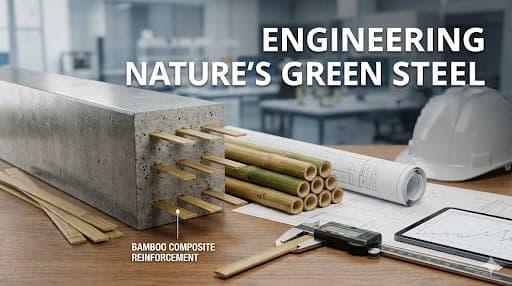
Bamboo Composite Reinforcement: Engineering Nature’s "Green Steel
1. Introduction
Concrete is the second most consumed substance on Earth after water. However, concrete is weak in tension, so it requires reinforcement. For over a century, mild steel rebar has been the undisputed standard for this role.
While steel is excellent structurally, it has major downsides: its production is energy-intensive, responsible for roughly 7-9% of global CO2 emissions, and it is expensive in developing nations.
This has led engineers to search for sustainable alternatives. The most promising natural candidate is Bamboo. Often called "vegetal steel" or "green steel," bamboo is a rapidly renewable grass with surprising mechanical properties.
However, a Civil Engineer cannot simply cut a bamboo stalk and place it inside wet concrete. To become a viable construction material, it must be engineered into Bamboo Composite Reinforcement (BCR).
2. The Engineering Logic: Why Bamboo?
From a structural perspective, bamboo is a natural composite material itself. It consists of strong cellulose fibers embedded in a lignin matrix (similar to how carbon fibers are embedded in epoxy in modern composites).
Key Mechanical Properties:
- Tensile Strength: The most attractive property of bamboo is its tensile strength along its fibers. Some species of bamboo can achieve tensile strengths of 200–400 MPa, which is comparable to mild steel (Grade 250) (Javadian et al., 2019).
- Strength-to-Weight Ratio: Bamboo is significantly lighter than steel. Its specific strength (strength divided by density) is actually higher than steel, making it very efficient.
- Sustainability: Unlike steel, which takes non-renewable ore to produce, bamboo grows rapidly and absorbs CO2 during its life cycle, making it a potentially carbon-negative material.
3. The Critical Engineering Challenges
If bamboo is so strong, why don't we use it everywhere? For university students, understanding the failure mechanisms is crucial. Raw bamboo has three major Achilles heels when placed in concrete:
- Water Absorption and Swelling: This is the biggest problem. Concrete is mixed with water. Dry bamboo is hygroscopic (it absorbs water like a sponge). When placed in wet concrete, raw bamboo absorbs water and swells, increasing its volume. This internal pressure cracks the surrounding concrete before it has even set. Later, as the concrete dries, the bamboo shrinks, leaving a gap and destroying the bond.
- Alkaline Attack: The pore water inside curing concrete is highly alkaline (pH > 13). This alkaline environment attacks the lignin (the natural glue holding bamboo fibers together), causing the bamboo to decompose over time.
- Weak Bond Strength: Steel rebar has ribs to grip the concrete. Bamboo has a smooth outer skin, leading to poor friction and slippage under load.
4. The Solution: Creating the "Composite"
To overcome these challenges, raw bamboo must be processed into an engineered composite. This turns a natural grass into a reliable construction material. The typical engineering process involves:
Step 1: Selection and Seasoning: Only mature bamboo (usually 3-5 years old) should be used, as young bamboo is weak. It must be properly dried to remove moisture and sugars that attract insects.
Step 2: Chemical Treatment: The bamboo splits or strips are often soaked in a solution (like Borax and Boric Acid) to prevent termite and fungal attacks.
Step 3: Surface Coating (The Critical Step): To stop water absorption and alkaline attack, the bamboo must be sealed. Engineers use various synthetic resins, such as epoxy or polyester resin, to coat the bamboo.
Step 4: Improving the Bond: To solve the "smooth skin" problem, fine sand is often sprinkled onto the wet epoxy coating. When it hardens, this creates a rough, sandpaper-like surface that bonds tightly with the concrete matrix (Archila et al., 2018).
5. Current Applications and Limitations
Bamboo Composite Reinforcement is not yet ready to replace steel in high-rise skyscrapers in Colombo. The variability in natural bamboo makes it difficult to codify in standards like the Eurocode yet.
However, it is highly viable for:
- Low-rise affordable housing (1 or 2 stories).
- Non-critical structural elements like pavement slabs, boundary walls, and lintels.
- Temporary structures where long-term durability is less critical.
6. Conclusion
Bamboo Composite Reinforcement represents a fascinating intersection of ancient materials and modern chemical engineering. It transforms a humble grass into a viable engineering material that can reduce the cost and carbon footprint of construction in the developing world. For civil engineering students, resolving the challenges of long-term durability and standardization of BCR remains one of the most exciting research frontiers today.
7. Bibliography
Archila, H., Kaminski, S., Trujillo, D., Zea Escamilla, E. and Harries, K.A. (2018). Bamboo Reinforced Concrete: A Critical Review. Proceedings of the Institution of Civil Engineers - Structures and Buildings, 171(8), pp. 611-628.
Javadian, A., Smith, I.F.C., Saeidi, N. and Hebel, D.E. (2019). Mechanical Properties of Bamboo Through Measurement of Culm Physical Properties for Composite Fabrication of Structural Concrete Reinforcement. Frontiers in Materials, 6, p. 15.
Xiao, Y., Inoue, M. and Paudel, S.K. (2023). Modern Bamboo Structures: Proceedings of the First International Conference on Modern Bamboo Structures (ICBS2023). Boca Raton: CRC Press.
Test Your Knowledge!
Click the button below to generate an AI-powered quiz based on this article.
Did you enjoy this article?
Show your appreciation by giving it a like!
Conversation (0)
Cite This Article
Generating...