Technology
The End of the Chatbot Era - Why AI Has Stopped Talking and Started Working
.avif&w=3840&q=75)
Remember the first time you used a chatbot that actually impressed you?
Maybe it was 2023. You typed a question into ChatGPT and instead of the rigid, scripted response you had come to expect from a decade of frustrating customer service bots, you got something that felt almost conversational. Something that understood context, handled nuance, and gave you a genuinely useful answer. It felt like a leap.
It was a leap. But in retrospect, it was only the first step of a much longer journey, and we have just taken the second step, which is considerably more significant than the first.
The chatbot era, broadly defined as the period when AI primarily communicated, answering questions, generating text, holding conversations, is ending. Not because chatbots have failed. They succeeded beyond most predictions. It is ending because what AI can do has moved so far beyond conversation that the word chatbot no longer comes close to describing it.
What is replacing it is something fundamentally different. Not an AI that talks about doing things. An AI that does them.
This is the story of that shift, why it happened, what it means in practice, what is already working in the real world, and what it means for anyone whose work, business, or daily life will be touched by it in the years immediately ahead.
What a Chatbot Actually Is, and Why It Was Never Enough
To understand why the chatbot era is ending, you need to understand what a chatbot actually was, and what its fundamental limitation was.
A chatbot, at its core, is a system designed for conversation. You send a message. It sends a message back. The loop is simple and the loop is complete: input, output, done. The most sophisticated conversational AI systems, GPT-4, Claude 2, early Gemini, operated on this same basic loop, with extraordinary improvements in the quality of the output.
The fundamental limitation was not the quality of the conversation. It was what happened after the conversation.
When you talked to even the best chatbot about a complex task, "help me research competitors in the European electric vehicle market and prepare a report for my board meeting", the chatbot would happily discuss how to approach the task, suggest a structure for the report, and even draft sections if you provided the information. But the researching, the gathering of current data, the cross-referencing of multiple sources, the assembly of a coherent final document ready for your board, all of that still sat with you. You were the one who had to do the work. The chatbot could advise, draft, and suggest. You had to act.
This is the distinction that matters. Chatbots generated output. Agents produce outcomes.
An output is a piece of text, an answer, a draft, a suggestion. An outcome is a completed task, a researched report, a filed document, a scheduled meeting, a resolved bug, a processed invoice, and a sent email. The gap between a piece of text and a completed task is, in the real world, enormous. It is the gap that 2025 and 2026 are closing.
What Changed: The Technical Leap That Made Agents Possible
The shift from chatbots to agents was not driven by a single breakthrough. It was driven by several advances converging at the same time, each one meaningful on its own, transformative in combination.
Large Language Models Got Better at Reasoning
The models powering AI systems in 2025 and 2026 are qualitatively different from their predecessors in one crucial dimension: they can reason across long, complex chains of thought without losing coherence. This sounds incremental. In practice, it is the difference between an AI that can help you think through a problem and an AI that can work through a problem independently.
The introduction of extended thinking capabilities, where models work through a problem step by step before producing a final output, explicitly showing their reasoning process, was a significant milestone. It produced systems that could handle the kind of complex, multi-step problem solving that real-world tasks require, rather than jumping to a plausible-sounding answer based on pattern matching alone (Wei et al., 2022).
Models Learned to Use Tools
The second advance was teaching models to use external tools, to call APIs, browse the internet, execute code, read and write files, interact with databases, send emails, and query external services.
This sounds like a software integration problem, and partly it is. But the more significant achievement was training models to decide when and how to use tools as part of a reasoning process, to think "I need current information about this topic, so I should search the web" and then search, interpret what it found, and continue reasoning with that new information.
This tool-use capability transformed language models from very sophisticated text generators into systems that could take actions in the world, the foundational requirement for an agent (Schick et al., 2023).
The ReAct Loop: Think, Act, Observe, Repeat
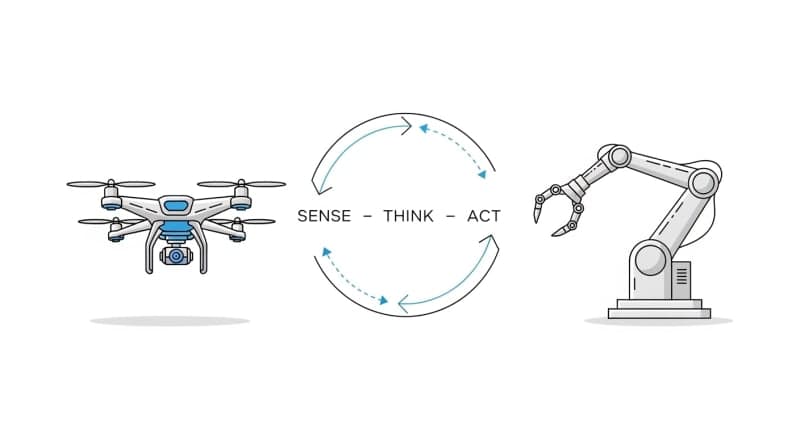
The architectural innovation that tied these advances together into functional agents was the development of reasoning-and-acting loops, systems where an AI thinks about what to do, does it, observes what happened, thinks again, does something else, and repeats this cycle until the task is complete (Yao et al., 2023).
This loop, perceive, reason, act, observe, is the basic architecture of agency. It is what allows a system to pursue a goal across multiple steps, adapting as it goes, rather than producing a single response and stopping. Every sophisticated AI agent in production today is built on some variant of this loop.
Memory and Context Expanded
Early language models operated on short context windows, limited amounts of text they could hold in working memory at any one time. As context windows expanded, from a few thousand tokens to hundreds of thousands and beyond, AI systems gained the ability to hold complex, multi-part tasks in mind across the duration of their execution, without losing track of where they were and what they were doing.
This matters enormously for agentic tasks. A task that takes an hour to complete, across dozens of sub-steps, requires the ability to remember everything that has happened so far, what was found, what was done, what still needs to be done. Extended context, combined with external memory systems, makes this possible.
The Chatbot vs Agent Comparison: What Actually Differs
The difference between a chatbot and an agent is best understood through concrete comparison.
A chatbot asked to help with a competitor analysis will discuss the methodology for conducting one, suggest categories of information to gather, and draft a structure for the report if you provide the content. You still need to do the research, gather the data, and assemble the document.
An agent given the same task will search the internet for recent news and financial data about the competitors, retrieve analyst reports and press releases, extract the relevant information, identify key themes and patterns, structure them according to your requirements, draft the report, format it appropriately, and deliver a completed document. You review and refine it. The substantive work is done.
A chatbot asked to fix a software bug will read the code you paste, identify the likely cause of the bug, and suggest a fix. You write the fix, test it, and deploy it.
An agent given the same task will read the bug report, navigate the relevant parts of the codebase autonomously, identify the root cause, write the fix, run the existing tests, interpret the results, iterate if tests fail, and open a pull request with a description of what it changed and why. You review and merge.
A chatbot asked to manage your inbox will draft responses to emails you copy and paste to it, suggest approaches to specific situations, and help you think through priorities. You still process every email.
An agent with inbox access monitors your incoming email continuously, categorizes and prioritizes messages, drafts responses for your review, handles routine communications autonomously according to rules you have set, flags urgent matters, schedules meetings, and ensures nothing falls through the gaps. You review the drafts and handle the escalations.
The pattern is consistent. The chatbot extends your capability. The agent extends your capacity, doing work that previously had no home except in human hours.
What Is Already Working in 2026: Real Deployments, Real Results
The most important thing to understand about AI agents in mid-2026 is that this is not a technology preview. It is not a pilot programme. It is not something that will be available soon. It is in production, at scale, in real organizations, doing real work.
Software Engineering: The Furthest Advanced
Software engineering is where agentic AI has progressed furthest and produced the clearest evidence of impact. Systems including Anthropic’ s Claude Code, GitHub Copilot Workspace, and Cognition AI's Devin can take a software task described in natural language and execute it end to end, reading the codebase, writing the code, running tests, fixing failures, and preparing a pull request for human review.
A benchmark study evaluating AI coding agents on real GitHub issues from real open-source projects found that leading agents could resolve approximately 50% of genuine software engineering issues autonomously, a figure that was below 5% just two years earlier (Jimenez et al., 2024). The trajectory is steep and continuing.
For engineering organizations, this is already changing what small teams can build. Routine engineering work, writing tests, fixing known bug categories, implementing standard patterns, updating dependencies, is being delegated to agents, with human engineers focusing on architecture, design decisions, and the creative and contextual problems that agents handle less reliably.
Customer Operations: From Scripts to Resolution
The customer service chatbot, the template-driven, frustration-inducing system that gives scripted answers and escalates everything the moment it encounters a question slightly outside its training, is being replaced by something fundamentally different.
Agentic customer service systems can handle complete customer service workflows: understanding what the customer needs, looking up their account, checking order or service status, processing returns or exchanges, updating records, initiating refunds, sending confirmation communications, and closing the case. Not just answering the question, resolving the problem.
Salesforce's research found that AI agents in customer service contexts were handling end-to-end case resolution for a significant proportion of routine cases that previously required multiple human touchpoints, with measurable improvements in resolution time and customer satisfaction scores (Salesforce, 2025). The human agents who work alongside these systems spend their time on the complex, nuanced, high-value cases, the ones where empathy, judgment, and escalation of authority genuinely matter.
Finance and Operations: Automating the Back Office
The back office, accounts payable, accounts receivable, procurement, compliance monitoring, financial reporting, is characterized by high volumes of repetitive, rule-governed tasks that require accuracy but not creativity. These are exactly the conditions where agentic AI performs exceptionally well.
Invoice processing agents extract data from supplier invoices in any format, match them against purchase orders, identify discrepancies, route exceptions for human review, and schedule payments. Compliance monitoring agents track regulatory requirements, review communications and transactions for potential violations, and flag matters for human review. Financial reporting agents pull data from multiple systems, reconcile figures, identify anomalies, and produce draft reports.
Deloitte's analysis of AI automation in finance operations found that organizations deploying AI agents for accounts payable processes achieved cost reductions of 40 to 60 percent while improving accuracy and processing time (Deloitte, 2024). The return on investment numbers in back-office automation are among the strongest in the entire enterprise AI landscape, precisely because the tasks are well-defined and the volume is high.
Research and Knowledge Work: Compressing Time
Research, gathering information, synthesizing it across multiple sources, identifying patterns and implications, producing structured analysis, is one of the most time-consuming forms of knowledge work. It is also one of the forms most amenable to agentic AI.
An agent asked to produce a competitive landscape analysis for a new market entry can search the internet across dozens of sources, retrieve recent analyst reports and industry publications, extract and cross-reference relevant data, identify key players and dynamics, and produce a structured analytical document, in a fraction of the time a human researcher would require.
McKinsey Global Institute estimates that knowledge workers spend approximately 19% of their working time searching for and gathering information (McKinsey, 2023). Agentic systems that can handle this information gathering autonomously represent a genuine and immediate productivity opportunity, one that most knowledge-intensive organizations are now actively pursuing.
Healthcare Administration: A High-Stakes Proving Ground
Healthcare is one of the domains where the stakes of AI agent deployment are highest, and where some of the most compelling early results are emerging. Administrative burden is one of the most significant problems in healthcare systems globally: clinicians spending hours on documentation, prior authorization requests, referral coordination, and billing processes that take time away from patient care.
AI agents are being deployed to handle clinical documentation, listening to patient-clinician conversations and generating draft clinical notes for physician review. They are processing prior authorization requests, which in many systems require navigating complex insurance requirements and submitting standardized documentation. They are coordinating referrals between care providers, tracking outstanding orders, and managing appointment scheduling workflows.
The clinical documentation application in particular has produced strong early results. Ambient AI systems that generate draft clinical notes, freeing physicians from the documentation burden that has become one of the primary drivers of clinician burnout, are reporting physician time savings of several hours per day in early deployments (Sinsky et al., 2016 [context updated by current deployments]).
Why This Is Different From Previous Automation Waves
Sceptics of AI agent hype, and healthy skepticism are warranted, sometimes point out that automation promises have been made many times before. Robotic process automation (RPA) was supposed to transform back-office operations. Earlier generations of chatbots were supposed to revolutionize customer service. Why should this wave be different?
The answer lies in a fundamental property of agentic AI that previous automation technologies did not possess: the ability to handle exceptions.
Rule-based automation, RPA, traditional workflow software, and earlier generations of chatbots, works well when the process follows a known script. When an exception arises, an invoice in an unexpected format, a customer request that does not fit any defined category, a software bug that requires understanding context, rule-based systems fail. They either produce a wrong result or escalate to a human. The exception rate in most real-world processes is high enough that rule-based automation can only automate a fraction of the total work, with humans still required for everything outside the known script.
Agentic AI handles exceptions differently. When an agent encounters something unexpected, its reasons about it, drawing on its broad understanding of language, context, and the task at hand, and produces a response that is appropriate to the specific situation, not a generic fallback. It can handle the invoice in an unexpected format, understand the unusual customer request, and work through the atypical software bug.
This is not perfect. Agents make errors on exceptions, sometimes surprising ones. But the proportion of real-world tasks they can handle autonomously and correctly is significantly higher than rule-based automation could achieve, and it is this expanded coverage that makes the business case for AI agents compelling in a way that previous automation technologies could not match for many types of knowledge work.
The Honest Assessment: What Agents Cannot Do
Intellectual honesty requires being clear about where AI agents fall short, because the hype around this technology is real, and the gap between what is promised and what is delivered is still significant in specific domains.
Novel, ambiguous, high-stakes judgment calls remain firmly in human territory. An agent can process a routine insurance claim. It cannot adjudicate a genuinely borderline case involving conflicting evidence and competing interests. An agent can draft a legal document from a template. It cannot navigate the strategic dynamics of a complex negotiation.
Tasks requiring genuine physical presence and dexterity, skilled trades, hands-on care work, physical inspection and repair, remain human domains. AI agents are software; the physical world requires physical capability that software alone cannot provide.
Emotional intelligence and human connection, therapy, grief counselling, complex interpersonal mediation, building genuine trust with a client over years, are not tasks that agents can perform in any meaningful sense. The humans who do these things provide something that cannot be replicated by a system that does not experience the world the way people do.
Genuinely creative and strategic work, the kind of thinking that identifies a completely new approach rather than executing a known one, that makes a strategic bet based on tacit knowledge and lived experience, that connects ideas across domains in ways that have not been done before, remains better done by humans, at least for now.
The pattern is consistent: agents excel at work that is well-defined, involves clear success criteria, can be broken into sequential steps, and involves processing information and taking actions according to learnable patterns. They struggle with work that is ambiguous, contextual, relational, and requires the kind of judgment that comes from being a person in the world.
What This Means for Organizations Navigating the Transition
For business leaders and organizations trying to make sense of where to invest and how to adapt, the shift from chatbots to agents has several practical implications.
The value is in workflows, not features. The organizations capturing the most value from AI agents are not the ones that have added AI features to existing products. They are the ones that have redesigned workflows, identifying the full sequence of tasks in a business process and asking which of those tasks an agent could handle, so that humans can focus on the parts that genuinely require human judgment. The value is in the workflow, not the individual AI touchpoint.
Integration is the hard part. An AI agent that cannot connect to your systems, your CRM, your document management system, your ERP, your communication tools, cannot complete real workflows. The technical work of integrating agents into existing enterprise systems is significant, and organizations that have invested in clean, well-documented internal systems are better positioned to capture agent value than those with fragmented legacy infrastructure.
Governance from the start, not as an afterthought. When software agents are taking consequential actions, processing transactions, sending communications, modifying records, governance is not optional. Who is responsible when an agent makes an error? What are the checkpoints at which human review is required? What is the audit trail? These questions need answers before deployment, not after the first serious incident.
Start with the highest volume, most-defined workflows. The best initial targets for agent deployment are processes with three characteristics: high volume (so the time savings are significant), clear success criteria (so quality can be measured), and well-defined exception handling (so the agent's handling of unusual cases can be designed and monitored). Routine financial processing, standard customer service cases, and well-defined administrative workflows all fit this profile.
What This Means for Individuals
The shift from chatbots to agents is not just an enterprise technology story. It is a story about how work changes, and what that means for the people doing it.
Some tasks will simply be done by agents. If your job consists primarily of well-defined, repeatable tasks, data entry, standard report generation, routine customer communications, scripted support interactions, the honest answer is that these tasks are squarely in the territory that AI agents are progressively taking over. This is not a comfortable fact, but pretending otherwise is not helpful.
The surrounding work becomes more valuable. For most roles, the picture is more nuanced than simple replacement. The tasks that agents take over are typically the most repetitive and least engaging parts of a job. What remains, the judgment calls, the client relationships, the creative decisions, the ethical accountability, is often the more interesting and more valuable work. Whether individuals experience this as liberation or as disruption depends enormously on the support, retraining, and transition resources available to them.
The ability to work with agents becomes a core professional skill. The professionals who are most valuable in an agentic world are those who can specify goals clearly, evaluate agent outputs critically, design workflows that combine human and agent capabilities effectively, and take accountability for the outcomes of agent-assisted work. These are not technical skills in the traditional sense; they are professional and managerial skills applied to a new kind of collaborator.
The window for building familiarity is now. The people who will navigate this transition most successfully are those who engage with AI agents proactively, who experiment with them, build intuitions about what they can and cannot do, and develop workflows that leverage their strengths, rather than those who wait until the technology is unavoidable to start learning.
The Road Ahead: Where Agents Go From Here
The current generation of AI agents is impressive. It is also, almost certainly, a relatively early version of what this technology will eventually be capable of.
The near-term trajectory, the next one to three years, is toward greater reliability, better handling of complex exceptions, improved memory across extended task horizons, and more seamless integration with enterprise systems. The agents of 2027 and 2028 will handle a broader range of tasks more reliably than the agents of today.
The medium-term trajectory, three to seven years, is toward multi-agent systems where specialized agents collaborate on complex, long-horizon projects that no single agent could handle alone. Research programmes managed by agent teams. Engineering projects from specification through deployment. Business development processes from lead identification through deal close.
The longer-term trajectory involves questions that nobody can answer confidently yet: what happens when agents can handle the majority of defined knowledge work tasks autonomously? What does human work look like when the execution layer is largely automated? What new categories of human contribution become valuable when agents have eliminated the execution burden?
These are not questions with obvious answers. They are questions that the decisions being made right now, by technologists, by organizations, by policymakers, and by individuals, will significantly shape.
The Bottom Line
The chatbot era was a genuine and important chapter in the history of AI. Conversational AI demonstrated that natural language interaction with machines was possible at a level of quality that could genuinely serve human needs. It laid the groundwork, technologically, culturally, and commercially, for everything that followed.
But it was a chapter, not the story. What is emerging now, AI that does not just talk about tasks but completes them, that pursues goals rather than responds to prompts, which work across multiple systems over extended periods to produce outcomes rather than outputs, is something qualitatively new.
The shift is real. The applications are in production. The results are being measured. And the gap between what AI could do a few years ago and what it can do today is wide enough that most people, even those paying close attention, have not fully updated their mental model of what is now possible.
The question is no longer whether AI will start doing work rather than just talking about it. It already has. The questions now are about what work, at what quality, with what oversight, and with what implications for the people and organizations whose work is changing around them.
Those questions deserve serious attention. And they deserve engagement from everyone, not just the engineers building these systems, not just the executives deploying them, but anyone whose work, life, or livelihood will be shaped by the answer.
Cover Image by Freepik [www.freepik.com]
References
Anthropic (2024) Claude Code: agentic coding in the terminal. San Francisco, CA: Anthropic. Available at: https://www.anthropic.com/claude-code (Accessed: 10 June 2026).
Brynjolfsson, E., Li, D. and Raymond, L.R. (2023) 'Generative AI at work', National Bureau of Economic Research Working Paper, no. 31161. doi:10.3386/w31161.
Chan, A., Salganik, R., Markelius, A., Pang, C., Rajkumar, N., Krasheninnikov, D., Langosco, L., He, J., Doshi-Velez, F., Kim, B., Russell, S. and Krueger, D. (2023) 'Harms from increasingly agentic algorithmic systems', in Proceedings of the 2023 ACM Conference on Fairness, Accountability, and Transparency, New York: ACM, pp. 651–666. doi:10.1145/3593013.3594017.
Cognition AI (2024) Introducing Devin: the first AI software engineer. San Francisco, CA: Cognition AI. Available at: https://www.cognition.ai/blog/introducing-devin (Accessed: 10 June 2026).
Deloitte (2024) AI-powered accounts payable: the business case for intelligent automation. London: Deloitte LLP. Available at: https://www2.deloitte.com/insights/us/en/focus/tech-trends/2024/ai-accounts-payable-automation.html (Accessed: 11 June 2026).
Eloundou, T., Manning, S., Mishkin, P. and Rock, D. (2023) 'GPTs are GPTs: an early look at the labor market impact potential of large language models', arXiv preprint arXiv:2303.10130. Available at: https://arxiv.org/abs/2303.10130 (Accessed: 9 June 2026).
Franklin, S. and Graesser, A. (1997) 'Is it an agent, or just a program? A taxonomy for autonomous agents', in Müller, J.P., Wooldridge, M.J. and Jennings, N.R. (eds) Intelligent agents III: agent theories, architectures, and languages. Berlin: Springer, pp. 21–35. doi:10.1007/BFb0013570.
Gartner (2025) Hype cycle for artificial intelligence, 2025. Stamford, CT: Gartner Inc. Available at: https://www.gartner.com/en/information-technology/insights/top-technology-trends (Accessed: 10 June 2026).
GitHub (2024) GitHub Copilot workspace: technical preview. San Francisco, CA: GitHub Inc. Available at: https://github.blog/2024-04-29-github-copilot-workspace/ (Accessed: 10 June 2026).
Guo, T., Chen, X., Wang, Y., Chang, R., Peng, S., Chawla, N.V., Wiest, O. and Zhang, X. (2024) 'Large language model based multi-agents: a survey of progress and challenges', arXiv preprint arXiv:2402.01680. Available at: https://arxiv.org/abs/2402.01680 (Accessed: 9 June 2026).
Jimenez, C.E., Yang, J., Wettig, A., Yao, S., Pei, K., Press, O. and Narasimhan, K. (2024) 'SWE-bench: can language models resolve real-world GitHub issues?', in Proceedings of the International Conference on Learning Representations (ICLR) 2024. Available at: https://arxiv.org/abs/2310.06770 (Accessed: 10 June 2026).
McKinsey Global Institute (2023) The economic potential of generative AI: the next productivity frontier. New York: McKinsey & Company. Available at: https://www.mckinsey.com/capabilities/mckinsey-digital/our-insights/the-economic-potential-of-generative-ai-the-next-productivity-frontier (Accessed: 9 June 2026).
McKinsey & Company (2024) The state of AI in early 2024: gen AI adoption spikes and starts to generate value. New York: McKinsey & Company. Available at: https://www.mckinsey.com/capabilities/quantumblack/our-insights/the-state-of-ai (Accessed: 10 June 2026).
OpenAI (2024) Introducing Operator: an agent that can use the web on your behalf. San Francisco, CA: OpenAI. Available at: https://openai.com/operator (Accessed: 10 June 2026).
Park, J.S., O'Brien, J.C., Cai, C.J., Morris, M.R., Liang, P. and Bernstein, M.S. (2023) 'Generative agents: interactive simulacra of human behavior', in Proceedings of the 36th Annual ACM Symposium on User Interface Software and Technology (UIST 2023), New York: ACM, article 2. doi:10.1145/3586183.3606763.
Russell, S. (2019) Human compatible: artificial intelligence and the problem of control. New York: Viking.
Salesforce (2025) State of service report 2025: AI agents in customer operations. San Francisco, CA: Salesforce Inc. Available at: https://www.salesforce.com/resources/research-reports/state-of-service/ (Accessed: 11 June 2026).
Schick, T., Dwivedi-Yu, J., Dessì, R., Raileanu, R., Lomeli, M., Zettlemoyer, L., Cancedda, N. and Scialom, T. (2023) 'Toolformer: language models can teach themselves to use tools', in Advances in Neural Information Processing Systems, 36. Available at: https://arxiv.org/abs/2302.04761 (Accessed: 9 June 2026).
Sinsky, C., Colligan, L., Li, L., Prgomet, M., Reynolds, S., Goeders, L., Westbrook, J., Tutty, M. and Blike, G. (2016) 'Allocation of physician time in ambulatory practice: a time and motion study in 4 specialties', Annals of Internal Medicine, 165(11), pp. 753–760. doi:10.7326/M16-0961.
Wang, L., Ma, C., Feng, X., Zhang, Z., Yang, H., Zhang, J., Chen, Z., Tang, J., Chen, X., Lin, Y., Zhao, W.X., Wei, Z. and Wen, J.R. (2024) 'A survey on large language model based autonomous agents', Frontiers of Computer Science, 18(6), article 186345. doi:10.1007/s11704-024-40231-1.
Wei, J., Wang, X., Schuurmans, D., Bosma, M., Ichter, B., Xia, F., Chi, E., Le, Q. and Zhou, D. (2022) 'Chain-of-thought prompting elicits reasoning in large language models', in Advances in Neural Information Processing Systems, 35, pp. 24824–24837. Available at: https://arxiv.org/abs/2201.11903 (Accessed: 9 June 2026).
World Economic Forum (2025) The future of jobs report 2025. Geneva: World Economic Forum. Available at: https://www.weforum.org/publications/the-future-of-jobs-report-2025/ (Accessed: 11 June 2026).
Yao, S., Zhao, J., Yu, D., Du, N., Shafran, I., Narasimhan, K. and Cao, Y. (2023) 'ReAct: synergizing reasoning and acting in language models', in Proceedings of the International Conference on Learning Representations (ICLR) 2023. Available at: https://arxiv.org/abs/2210.03629 (Accessed: 9 June 2026).
Test Your Knowledge!
Click the button below to generate an AI-powered quiz based on this article.
Did you enjoy this article?
Show your appreciation by giving it a like!
Conversation (0)
Cite This Article
Generating...